
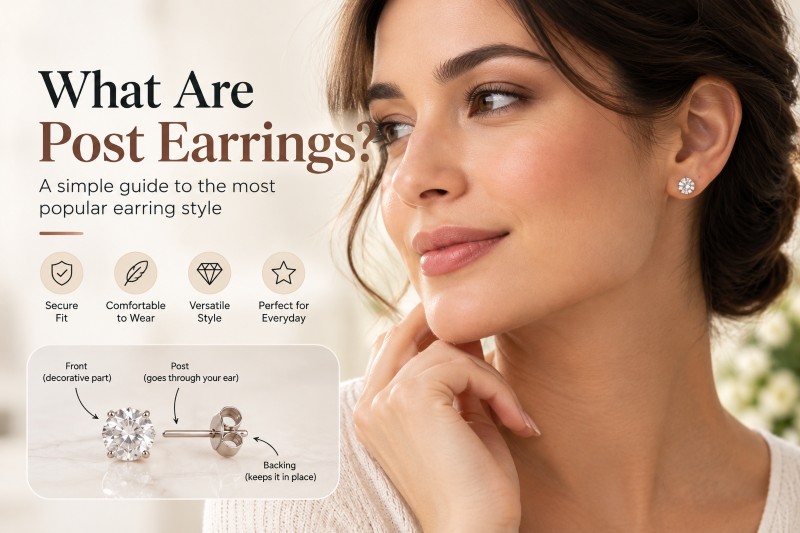
If you’ve ever shopped for jewelry, you’ve likely come across the term “post earring”—often used interchangeably with “stud earring.”
However, calling every post earring a stud isn’t entirely accurate. While all traditional studs use posts, many hoops, drop earrings, and jacket earrings use posts too.
Understanding what a post earring actually is—along with its structural parts, gauge thickness, and backing types—is essential to choosing comfortable, secure, and irritation-free jewelry for everyday wear.
What Is a Post Earring? (The Anatomy Breakdown)
A post earring refers to any earring that fastens to your ear using a straight metal pin (the post) that passes through a pierced earlobe and secures on the other side with a removable backing.
Unlike drop earrings with curved wire hooks (like French hooks or fishhooks) or hinged lever-backs, a post earring relies on a straight shaft that holds the decorative front flush or suspended against the ear.
| Earring Component | What It Is | Purpose |
|---|---|---|
| Decorative Front | Gemstone, metal, pearl, or other decorative element | Creates the visible design and style of the earring |
| Metal Post | Thin metal pin attached to the decorative front | Passes through the pierced earlobe to secure the earring |
| Notch | Small groove near the end of the post | Helps the backing stay securely in position |
| Fastener / Backing | Removable piece fitted onto the metal post | Holds the earring securely against the earlobe |
The 3 Core Components of a Post Earring:
- The Decorative Front: The visible design sitting on the front of your ear (a diamond, pearl, gold sphere, or dangling charm).
- The Post (Shaft): The thin metal rod soldered to the back of the decorative front that slides through your piercing.
- The Earring Back (Clasp): The removable fastener that slides onto the post behind your earlobe to keep the earring from falling out.
Post vs. Stud Earrings: What’s the Difference?
The terms are often confused, but the difference comes down to a part versus a style:
| Feature | The Earring Post | The Stud Earring |
| Definition | The physical straight metal pin component. | A specific style of compact, non-dangling earring. |
| Scope | Found on studs, drop earrings, hoop posts, and jacket earrings. | Must feature a post to sit flat against the earlobe. |
| Analogy | The post is the engine of the car. | The stud is one type of car that uses the engine. |
💡 Takeaway: Every stud earring has a post, but not every earring with a post is a simple stud!
5 Common Types of Earring Posts
Not all posts are smooth straight rods. Jewelers engineer different post shafts depending on security requirements and ear comfort:
| Earring Post Type | Design / Structure | Key Feature |
|---|---|---|
| Standard Friction Post | Straight post with a notch or notches | Uses a friction-fit backing to hold the earring securely |
| Threaded Screw Post | Post with spiral screw ridges | Screw-on backing provides a secure, adjustable closure |
| Flat-Back / Labret Post | Post with a flat disc backing | Low-profile design that sits comfortably behind the earlobe |
| Notched Safety Post | Post with a deeper locking groove | Designed to provide additional security against accidental removal |
| Hinged Hoop Post | Curved or straight hinged post | Snaps into a built-in closure for a convenient hoop-style fit |
1. Standard Friction Posts (Friction Backs)
The most common post style in fashion and fine jewelry. It features a smooth metal shaft with one or two tiny safety notches near the end to catch the backing if it slides backward.
2. Threaded Posts (Screw Backs)
Features small spiral ridges along the post shaft—functioning like a mini bolt. The backing must be turned and screwed on tightly, offering high security for expensive diamond or gold earrings.
3. Flat-Back / Labret Posts (Internally Threaded)
Popular in body piercing and modern ear stacks. Instead of a traditional backing, the post has a smooth, flat disc on the back. The front decorative stud screws into the hollow post shaft from the front.
4. Notched Safety Posts
Features a deep groove etched near the tip of the post. When paired with specialized locking backs (like La Pousette backs), internal springs lock directly into the groove for high-value protection.
5. Hinged / Latch Posts
Found on hoop and huggie earrings. A straight or slightly curved post is hinged at one end, passing through the ear lobe and clicking directly into a latch on the back of the hoop.
The 6 Best Earring Backings for Post Earrings
Pairing your post with the right backing determines how comfortable and secure your earrings will feel throughout the day:
| Earring Back Type | How It Works | Best Used For | Security Level |
| Push Backs (Butterfly) | Friction-based metal scrolls slide onto the post. | Everyday lightweight studs & drops. | 🟡 Moderate |
| Screw Backs | Threaded cap screws clockwise onto the post. | High-value diamonds & kids’ earrings. | 🟢 High |
| Flat Backs (Labret) | Flat metal disc rests flush against back of ear. | Sleeping, cartilage piercings, 24/7 wear. | 🟢 High |
| Bullet / Clutch Backs | Metal cylinder with a silicone/rubber grip ring. | Heavier post earrings to prevent droop. | 🟢 High |
| La Pousette (Locking) | Squeeze-trigger mechanism locks into post grooves. | Expensive luxury studs. | 🟢 High |
| Rubber / Silicone Stop | Clear, soft silicone cylinder pushed onto post. | Sensitive skin, casual wear, backup security. | 🟡 Moderate |
Earring Post Sizes & Gauges: Why Thickness Matters
If an earring post feels painful or difficult to insert, you may be using the wrong gauge (post thickness). Standard earlobe piercings use specific post dimensions:
- Standard Post Gauge (20G to 18G): Measures between
0.8 mmand1.0 mmin diameter. This is the global standard for standard lobe piercings. - Thick Post Gauge (16G): Measures
1.2 mmin diameter. Common in professional cartilage, helix, and body piercings. - Standard Post Length: Most standard posts measure 10 mm to 12 mm long. If a post is longer than 12 mm, it may poke the neck while sleeping or wearing headphones.
Best Metals for Post Earrings (Hypoallergenic Options)
Because the post stays in direct contact with skin tissue inside your piercing hole, choosing the right metal prevents redness, swelling, and nickel allergies:
| Metal Type | Allergy Risk Level | Best For |
|---|---|---|
| Titanium (Grade 23) | 🟢 Zero Risk | Fresh piercings, ultra-sensitive ears |
| Platinum | 🟢 Zero Risk | High-end luxury wear |
| Solid 14K/18K Gold | 🟢 Very Low Risk | Daily fine jewelry |
| Niobium | 🟢 Zero Risk | Sensitive ears, vibrant colors |
| 925 Sterling Silver | 🟡 Low-Moderate | General everyday wear |
| Base Metals/Nickel | 🔴 High Risk | Fast fashion (AVOID) |
How to Protect and Care for Post Earrings
Post earrings are small and prone to bending, tarnishing, or getting lost without proper care.
How to Fix a Bent Earring Post (Without Snapping It)
If a thin sterling silver or gold post gets bent out of shape:
- Wrap the jaws of a small pair of flat-nose pliers with masking tape (to prevent scratching the metal).
- Gently grip the post at the point of the bend.
- Apply slow, steady pressure to straighten the post back to a 90-degree angle relative to the earring front. Never bend it back and forth rapidly, as metal fatigue will cause it to snap.
Daily Care & Safety Tips:
- Remove Before Sleeping: Standard friction posts poke into the skin behind the ear when pressing against a pillow, which can bend the post or irritate the piercing. (Switch to flat-back labrets if you prefer sleeping in earrings).
- Clean the Shaft Regularly: Dead skin cells, soap residue, and oils collect on the post shaft. Clean the posts weekly with alcohol pads or warm soapy water.
- Check Friction Backs for Tightness: Over time, butterfly backs expand and lose their grip. Pinch the two circular loops of a butterfly back slightly inward to restore a tight friction grip on your post.

 By
By