
That heirloom gold chain sitting in your jewelry box could be worth thousands—or it could be a $15 copper fake waiting to turn your neck green.
Necklaces are among the most difficult jewelry items to authenticate at home. Unlike a solid gold ring or gold coin, a necklace is a complex mechanical assembly. It consists of dozens—sometimes hundreds—of individual interlocking wire loops, soldered solder joints, spring-loaded clasps, connecting tags, and dangling bails.
Because of this unique construction, basic tests designed for rings often fail on necklaces. A fake gold chain might feature a real gold clasp from a past repair, while a 100% genuine solid gold box chain might stick to a magnet because of the microscopic steel spring hidden inside its lobster claw fastener.
If you’ve inherited a vintage gold chain, purchased a pre-owned piece online, or want to verify a gift, this master guide walks you step-by-step through 9 necklace-specific diagnostic tests, moving from non-destructive visual inspections to precise chemical and physical evaluation.
Real Gold vs. Fake Gold Necklaces: Diagnostic Reference Matrix
Before diving into individual testing procedures, consult this master diagnostic table to understand how different types of gold-toned chains behave across standard tests:
| Test Method | Solid Gold Necklace (10K–24K) | Hollow Solid Gold Chain | Gold-Filled (GF) / Vermeil | Cheap Gold-Plated (GP) / Base Metal |
| Hallmark Inspection | Stamped 10K, 14K, 18K, 417, 585, 750 | Stamped 10K/14K + optional “Hollow” mark | Stamped 1/20 14K, GF, or 925 | Stamped GP, GEP, HGP, or unmarked |
| Magnet Test | 0% attraction on chain; mild pull only at clasp spring | 0% attraction on chain; mild pull only at clasp spring | 0% attraction (if silver core) or magnetic (if steel core) | Strong, immediate pull across all links |
| Friction Point Check | Uniform gold color inside link-to-link joints | Uniform gold color inside joint gaps | Slow wear over years; silver/brass exposes eventually | Discolored gray, red, or green metal visible in joints |
| Skin Chemical Test | Never turns skin green, black, or blue | Never turns skin green, black, or blue | Clean until gold layer wears through completely | Leaves green copper or dark nickel marks within hours |
| Nitric Acid Test | Zero reaction; drops stay clear | Zero reaction on surface (unless cut to hollow core) | Reaction occurs once surface layer is scratched | Immediate fizzing, green foam, or dark tarnishing |
| Thermal Shift Test | Rapid cold-to-warm heat transfer on skin | Rapid cold-to-warm heat transfer | Moderate heat transfer | Remains warm or heats up very slowly |
Understanding Gold Types: Solid, Hollow, Plated, and Filled
When asking “is my necklace real gold?”, it is vital to understand that “real gold” isn’t a single category. Necklaces are manufactured using five primary metallurgical structures:
| Gold Type | Construction / Composition |
|---|---|
| Solid Gold | 100% gold alloy throughout the entire link body. |
| Hollow Gold | Solid gold alloy on the outside with a hollow air core inside. |
| Gold-Filled | A thick mechanical shell of solid gold heat-bonded to a brass or silver core. |
| Gold Vermeil | A thick 2.5-micron gold layer electroplated specifically over 925 Sterling Silver. |
| Gold-Plated | A microscopic flash layer of gold electroplated over inexpensive brass, copper, or nickel. |
- Solid Gold Chains: Made from pure gold melted together with stabilizing alloy metals (like copper, silver, or zinc) throughout the entire cross-section of every link. Solid gold never peels, flakes, or rusts.
- Hollow Solid Gold Chains: Made with genuine Karat gold alloy (such as 14K or 18K), but constructed around a removable iron or copper core that is dissolved away with acid during manufacturing. The result is a real gold chain that is lightweight and more affordable.
- Gold-Filled (GF) Necklaces: Features a thick outer sheet of genuine Karat gold heat-bonded to an inner base metal core. Gold-filled chains contain significantly more real gold than plated chains and can pass several basic home tests for years before wearing down.
- Gold Vermeil: A premium form of plating where solid gold (at least 10K purity) is electroplated over a base of 925 Sterling Silver. If the surface wears down, you will find high-value silver rather than cheap brass.
- Gold-Plated (GP / GEP) Chains: Base metal (brass, copper, or nickel) dipped in a micro-thin bath of gold liquid. The gold layer is often less than 0.5 microns thick and rubs off within months of regular wear.
Phase 1: Zero-Risk Visual & Structural Audits
Always start your investigation with non-destructive visual checks. Because necklaces have multiple components, you must audit what jewelers call The Necklace Triad.
1. Audit “The Necklace Triad” for Purity Stamps
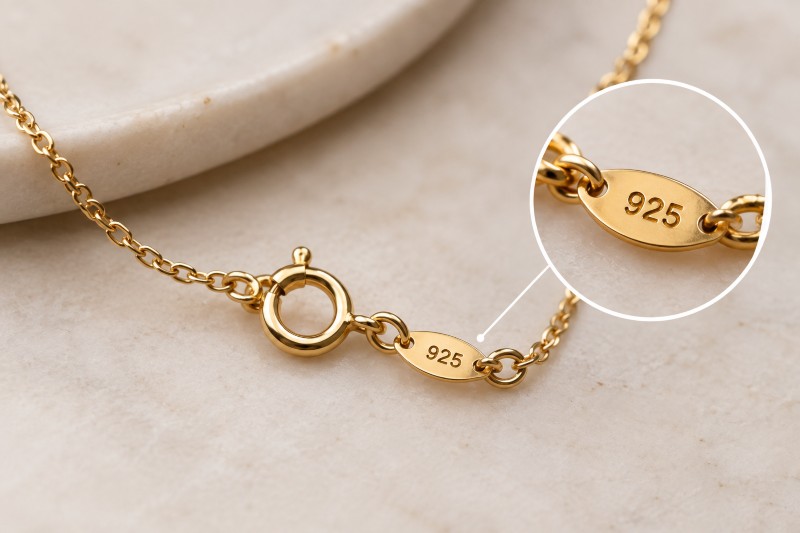
Unlike a ring—which only has one inner band to stamp—a necklace has three separate potential hallmark locations. Counterfeiters often stamp a fake hallmark on one piece while neglecting the others.
Grab a 10x jeweler’s loupe or zoom in using your smartphone camera with bright lighting, and inspect these three precise points:
- The Clasp Lever or Body: Check the flat trigger of a spring ring or the side panel of a lobster claw.
- The Attached End Tag: Look for a tiny flat teardrop tag attached between the end link and the clasp.
- The Connecting Jump Rings: Check the circular wire loop that bridges the chain to the fastener.
Standard Karat Ratings vs. European Fineness Numbers
Genuine solid gold necklaces feature stamps indicating their exact percentage of pure gold content:
- 10K (or 417): 41.7% pure gold — Highly durable, common in North America.
- 14K (or 585): 58.5% pure gold — The industry standard for fine gold chains.
- 18K (or 750): 75.0% pure gold — Rich yellow color, traditional in fine European & luxury jewelry.
- 22K (or 916): 91.6% pure gold — Soft, vibrant yellow metal common in High-Carat Asian jewelry.
- 24K (or 999): 99.9% pure gold — Pure gold (rarely used for full chains due to extreme softness).
⚠️ Plating Codes That Indicate “Not Solid Gold”
If you find numbers alongside any of the following letter combinations, the necklace is not solid gold:
- GP / G.P.: Gold Plated
- GF / G.F.: Gold Filled (e.g.,
1/20 14K GF) - GEP / GE: Gold Electroplated
- HGP / H.G.E.: Heavy Gold Plate / Heavy Gold Electroplate
- RGP: Rolled Gold Plate
- 925: Sterling Silver core (If gold-colored, this indicates Gold Vermeil, not solid gold).
🛑 The Replacement Clasp Trap: Necklace clasps break easily. If a real gold chain’s original clasp broke, an owner might have replaced it with a cheap gold-plated clasp (or vice-versa). Never stop your test after checking the clasp alone. You must examine the chain links themselves.
2. Inspect Joint Friction Gaps Under High Magnification
The movement of a chain creates constant friction. As you wear a necklace, the inside curve of each link rubs continuously against the neighboring link.
Over time, this mechanical rubbing grinds away surface electroplating, exposing whatever metal lies beneath.
Step-by-Step Joint Inspection:
- Lay the necklace flat under a bright LED desk lamp.
- Take a 3-inch section of the chain and bend it back on itself to force the interlocking link joints open.
- Look deep inside the inner loops where link wire contacts link wire.
- Solid Gold Result: The color inside the joint gap is identical to the smooth outer surface. It remains warm yellow, white, or rose gold without flaking or discoloration.
- Plated/Fake Gold Result: You will spot tiny streaks of dull gray steel, reddish copper, yellow brass, or greenish corrosion inside the friction points.
3. Check Jump Ring Construction: Soldered vs. Pinched
In fine jewelry manufacturing, gold wire is expensive, but structural security is paramount. A genuine gold necklace is built to protect the valuable chain from falling off the wearer’s neck.
Look closely at the jump rings—the small circular wire loops connecting the clasp mechanism to the main length of the chain:
- Real Gold Construction: Real gold jump rings are almost always hard-soldered shut. Jewelers use gold solder to completely fuse the joint seam into a seamless solid ring. You should see a tiny smooth bump or a completely invisible seam where the wire ends meet.
- Fake/Costume Construction: Imitation chains frequently use open, pinched jump rings. Because base metals are difficult to solder cleanly without melting thin gold plating, cheap manufacturers simply pinch the wire ends together using pliers, leaving a visible gap.
Phase 2: Physical & Mechanical Diagnostics
If visual audits pass, move to physical tests to evaluate how the metal interacts with magnetic fields, gravity, heat, and skin chemistry.
4. The Isolated Clasp Magnetic Test
Pure gold is non-magnetic. However, testing a necklace with a magnet requires an understanding of how clasps operate mechanically.
The Internal Spring Exception
Inside every real gold lobster claw or spring-ring clasp sits a tiny steel tension coil spring. Gold is too soft to act as a spring, so manufacturers must use steel inside the clasp mechanism. Therefore, a real gold necklace may exhibit a micro-pull strictly at the clasp trigger.
| Bracelet Component | Expected Magnetic Response | What It Means |
|---|---|---|
| Chain Links | 0% Magnetic Pull | Must not move toward or attach to the magnet. |
| Clasp Outer Shell | 0% Magnetic Pull | Must not move toward or attach to the magnet. |
| Clasp Internal Spring | Microscopic Pull | A very small magnetic response can be normal because of the internal spring mechanism. |
How to Perform the Test Properly:
- Use a high-strength Neodymium magnet (rare-earth magnet), not a weak refrigerator magnet.
- Stretch the necklace straight across a non-metallic surface (wood or glass).
- Bring the magnet close to the middle chain links, staying 3 inches away from the clasp.
- Slowly slide the magnet down the full length of the chain links.
- Real Solid Gold Result: The chain links show zero movement, zero attraction, and zero resistance to being moved. When you touch the magnet to the clasp body, you may feel a tiny twitch coming exclusively from the internal steel spring coil.
- Fake Gold Result: The chain links jump up, snap to the magnet, or slide toward it across the table. This confirms an iron, nickel, or steel base core under the gold finish.
5. The Thermal Shift (Body Heat) Conductivity Check
Precious metals like gold and silver are extraordinary conductors of thermal energy. Base metals like brass, iron, or zinc transfer heat much slower.
Because a gold chain consists of numerous open wire loops spread across your skin, it reacts rapidly to ambient temperature shifts.
How to Test Thermal Transfer:
- Place your necklace flat on a cold stone surface (like a granite countertop) or inside a refrigerator for 2 minutes.
- Pick up the cold necklace and lay the chain immediately across the sensitive skin of your inner forearm or wrist.
- Count how many seconds it takes for the icy feeling to dissipate.
- Real Gold Result: The necklace feels ice-cold for 1 to 2 seconds, then instantly absorbs your body heat and feels warm against your skin.
- Fake Gold Result: The metal feels lukewarm from the start or retains a cold, dull heavy chill for several seconds without rapidly matching your skin temperature.
6. The Skin Oxidation & Makeup Reaction Test
It is a common myth that “if jewelry turns your skin green, it’s fake.” While true for cheap base metals, skin discoloration requires nuanced interpretation when testing gold chains.
Direct Sweat Test
- Clean a 2-inch section of your necklace with warm water and dry it thoroughly.
- Hold the chain tightly clamped inside your sweaty palm for 3 minutes.
- Rub the chain firmly back and forth against the skin of your inner wrist.
- Real Gold Result: Leaves no mark on your skin. Solid gold is chemically inert and will not react with sweat or skin acids.
- Fake Gold Result: Leaves a distinct green, blue, or black streak. This occurs because copper or nickel base metals oxidize when exposed to sweat, forming copper sulfate or nickel salts on your skin.
The Foundation Cosmetic Test (Detecting Micro-Abrasions)
If you want to verify gold purity quickly without chemicals, use liquid makeup foundation:
- Apply a small swab of liquid foundation or face powder to the back of your hand and let it dry completely.
- Lightly rub a link of your gold necklace across the dried makeup.
- Real Gold Result: Leaves a dark black streak on the makeup.
- Why this happens: Liquid foundations contain micro-particles of zinc oxide or titanium dioxide. These microscopic crystals are harder than gold, shaving off ultra-fine micro-particles of real gold that appear as a dark line. Fake soft base metals often leave no line at all.
Phase 3: Chemical & Surface Scratch Testing
Caution: The tests in this section involve minor physical wear or acid exposure. Perform these checks on an end link near the clasp, never on the front center of a decorative chain.
7. The Unglazed Ceramic Scratch Test
Ceramic scratch testing evaluates the hardness and core color of the underlying metal.
How to Perform the Test:
- Obtain an unglazed ceramic tile (the rough back edge of a bathroom tile or the unglazed bottom ring of a ceramic coffee mug).
- Select an inconspicuous end link near the clasp tag.
- Drag the link firmly across the unglazed ceramic surface for 1/2 inch.
Real Gold Track:    ==================== (Bright Gold/Yellow Streak)
Fake Gold Track:    -------------------- (Dark Black or Grey Streak)
- Real Gold Result: Leaves a smooth, bright gold/yellow streak on the ceramic.
- Fake Gold Result: Leaves a jagged, dark black, brown, or charcoal-grey streak, revealing base metals scraping off under the surface layer.
8. The Controlled White Vinegar Bath
White vinegar contains acetic acid. While mild, acetic acid is strong enough to react with nickel, brass, and copper, while leaving solid karat gold untouched.
How to Test:
- Use an eyedropper to place 2 drops of plain white vinegar directly onto an end link of the chain.
- Let the vinegar sit undisturbed on the metal for 15 minutes.
- Observe the metal carefully under good lighting, then rinse with clean tap water.
- Real Gold Result: The metal shows zero reaction. It remains bright, shiny, and untarnished.
- Fake/Plated Gold Result: The liquid changes color slightly, or the metal underneath turns dark brown, black, or greenish-gray where the vinegar reacted with base alloys.
9. The Professional Acid Touchstone Test
Acid testing is the gold standard for jewelers worldwide. It uses nitric acid solutions calibrated to specific Karat thresholds (10K, 14K, 18K, 22K).
How an Acid Touchstone Test Works:
- The Streak: The tester rubs an end link of the necklace across a smooth black slate stone (touchstone) to leave a thin line of metal particles.
- The 14K Acid Drop: A drop of 14K nitric acid testing solution is applied directly over the streak on the slate.
- The Reaction Evaluation:
- If the streak dissolves instantly: The necklace is base metal or under 10K gold.
- If the streak fizzes brown: The necklace is low-purity gold (e.g., 10K tested against 14K acid).
- If the streak stays sharp and clear: The necklace is at least 14K solid gold.
- Higher karat acids (
18K,22K) are then applied step-by-step to pinpoint the exact Karat purity.
🛠️ DIY Acid Kit Safety: You can purchase gold testing acid kits online, but always wear safety goggles and nitrile gloves. Nitric acid burns skin instantly. Never apply acid directly onto a necklace chain unless you are testing a scrap piece, as it will permanently burn a hole through plated jewelry!
Advanced Counterfeit Warnings: The Tungsten & Heavy-Plating Threat
As precious metal values rise, counterfeiters have developed sophisticated techniques to bypass standard home tests. When authenticating high-value gold chains (such as heavy Cuban links, Rope chains, or Franco chains weighing over 30 grams), watch out for these two advanced threats:
1. Gold-Plated Tungsten Chains
Tungsten has a density (19.25 g/cm³) that almost perfectly matches pure gold (19.3 g/cm³).
- The Trap: A tungsten chain plated in 14K gold will pass the float test, feel heavy in your hand, pass the thermal test, and show correct Karat stamps.
- How to Spot It: Tungsten is extremely rigid and non-magnetic. If a heavy chain feels unusually stiff, cannot bend smoothly between links, or resists light twisting, have it tested electronically.
2. Heavy-Gauge Gold Filled (Rolled Gold)
Gold-filled chains feature a real gold outer sheet that can be up to 100 times thicker than electroplating.
- The Trap: A 1/20 14K Gold-Filled chain will pass magnet tests, skin tests, ceramic scratch tests, and vinegar tests because the outer shell is genuine 14K gold.
- How to Spot It: You must inspect the end tags for
GFor1/20stamps, or have a jeweler use XRF spectrometry to read beneath the surface layer.
When to Seek Professional Jeweler Verification
While DIY tests provide strong initial evidence, high-value family heirlooms or major purchases deserve non-destructive professional appraisal.
When you take your necklace to a certified jeweler or assay office, they utilize non-destructive diagnostic tools:
- X-Ray Fluorescence (XRF) Spectrometry: An XRF scanner fires high-energy X-rays at the chain. The metal emits fluorescent X-rays unique to its elemental makeup, providing an exact percentage readout of gold, silver, copper, nickel, and zinc in under 30 seconds—without scratching the chain.
- Ultrasonic Density Testers: Measures how sound waves travel through the core of a link to detect hidden tungsten or brass cores inside thick gold chains.
- Electronic Conductivity Testers: Measures electrical resistivity across links to confirm exact Karat purity instantly.
Frequently Asked Questions (FAQ)
Can a fake gold necklace have a 14K or 18K stamp?
Yes. Counterfeiters frequently stamp fake metal with fake 14K, 18K, or 585 hallmarks. Never rely on a stamp alone; always cross-verify using magnetic, joint friction, and skin tests.
Why is my solid gold necklace turning dark near the clasp?
Solid gold does not tarnish, but low-karat gold (like 10K or 14K) contains non-gold alloy metals like copper and silver. If exposed to harsh hair products, perfume, sulfur soaps, or chlorine pools, these alloy metals can discolor on the surface. A simple polishing cloth will instantly restore genuine gold.
Does white gold test differently than yellow gold?
No. Solid white gold follows the exact same hallmark rules (14K, 18K, 750) and is non-magnetic. However, because white gold is routinely plated with rhodium to give it a bright mirror finish, avoid doing ceramic scratch tests on white gold chains as it can scratch off the protective rhodium layer.
Why does my real gold chain feel lightweight?
If your chain passed magnet, hallmark, and skin tests but feels light, it is likely a hollow gold chain. Manufacturers construct real karat gold tube links around hollow air centers to create voluminous, affordable chains that are 100% real gold inside and out.


 By
By