
If you’ve ever bought a bangle that either wouldn’t slide past your knuckles or slipped right off your wrist, you already know why sizing matters more with bangles than with almost any other piece of jewelry. Unlike a bracelet with an adjustable clasp, most bangles are fixed, rigid circles — which means there’s no margin for guessing.
The good news: measuring your bangle size correctly takes about two minutes and requires nothing you don’t already have at home. Here’s exactly how to do it, plus how to read a bangle size chart, handle sizes that fall in between, and avoid the mistakes that lead to returns.
Why Bangle Sizing Is Different From Rings and Bracelets
A ring only needs to fit around one finger joint. A bracelet with a clasp can be adjusted or has some flexibility. A solid bangle, on the other hand, has to do two things at once: slide over your entire hand (your widest point) and then sit comfortably on your wrist (a narrower point). That’s why the hand — not the wrist — is what you actually need to measure.
Get this step wrong, and you’ll end up with a bangle that’s technically the right “wrist size” but physically won’t go over your knuckles.
What You’ll Need
- A soft measuring tape (a sewing tape works perfectly), or
- A strip of paper or a piece of string plus a ruler
- A bangle that already fits well, if you have one
Any of these will get you an accurate measurement — pick whichever is easiest to find right now.
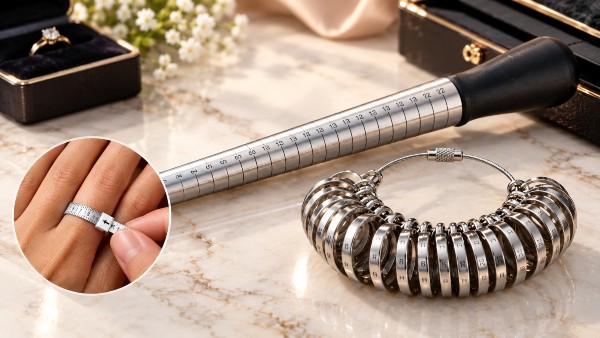
Method 1: Measure Your Hand (Most Accurate for New Bangles)
This is the standard method used by most jewelers, and it’s the one to use if you don’t already own a bangle that fits.
- Cup your hand as if you were about to slide a bangle over it — bring your thumb in toward your palm to make your hand as narrow as possible.
- Wrap the measuring tape around the widest part of your hand, which is usually across the knuckles, just below where your fingers meet your palm.
- Note the measurement in inches or centimeters. This number is your hand circumference.
- Compare it to a bangle size chart (below) to find your corresponding size.
If you’re using a strip of paper or string instead of a tape measure, wrap it around your hand the same way, mark where it overlaps, then lay it flat against a ruler to get the length.
Method 2: Measure a Bangle You Already Own
If you have a bangle that fits the way you like, this is the fastest and most foolproof method, since it skips the hand-shape guesswork entirely.
- Lay the bangle flat on a table.
- Measure the inner diameter — the distance straight across the inside of the circle, not the outer edge.
- Use that measurement directly, or convert it to circumference by multiplying the diameter by 3.14 (π) if the size chart you’re using is listed in circumference rather than diameter.
This method is especially useful when shopping online from a brand whose size chart lists inner diameter rather than hand circumference.
Method 3: Use an Online Bangle Size Calculator
Many jewelry retailers offer a simple size calculator: you enter your hand circumference and preferred fit (snug, standard, or loose), and it recommends a size. This is a good shortcut once you already have your hand measurement from Method 1 — it just saves you from cross-referencing a chart manually.
Bangle Size Chart: Hand Circumference, Diameter, and Fit
Here’s a general reference chart converting hand measurements into standard bangle sizing. Because sizing conventions vary by region and brand, always double-check against the specific retailer’s chart before ordering, but this will get you very close.
| Hand Circumference | Inner Diameter | Typical Size Label | Fit |
|---|---|---|---|
| 6.75″ – 7.0″ | ~2.25″ (5.7 cm) | XS / 2.4 | Snug |
| 7.0″ – 7.5″ | ~2.375″ (6.0 cm) | S / 2.6 | Standard |
| 7.5″ – 8.0″ | ~2.5″ (6.3 cm) | M / 2.8 | Standard–Relaxed |
| 8.0″ – 8.5″ | ~2.625″ (6.7 cm) | L / 2.10 | Relaxed |
| 8.5″ – 9.0″ | ~2.75″ (7.0 cm) | XL / 2.12 | Loose |
A quick way to sanity-check any chart: inner diameter is roughly your hand circumference divided by π (3.14), minus a small allowance so the bangle can still slide over comfortably.
What If You’re Between Two Sizes?
This happens more often than you’d think, and the right call depends on the bangle’s construction:
- Solid, non-opening bangles: size up. A bangle that’s slightly loose is far more comfortable than one you have to force over your knuckles.
- Bangles with a hinge, clasp, or opening: you can size down slightly for a closer fit, since you’re not forcing it over your whole hand.
- If you like a snug, close-to-the-wrist look: you can typically go down about a quarter inch from your hand measurement — but be careful when putting it on and taking it off, especially with rigid metals that can bend under pressure.
Solid Bangles vs. Cuffs vs. Hinged Bangles: Sizing Differences
Not all bangles are sized the same way, and knowing which type you’re buying changes how you should measure.
- Solid/round bangles must clear your full hand width — always size based on your hand circumference, not your wrist.
- Cuff bangles have an opening and flex slightly, so they’re more forgiving. Many are sold as one adjustable size that fits a range of wrists.
- Hinged bangles open on a small hinge, letting you fasten them around the wrist directly — these can fit closer to actual wrist size rather than hand size.
- Kadas (a heavier, wider style of bangle) tend to run larger and looser by design, since their bulkier structure needs to slide on with ease. If you’re between sizes on a kada, size up rather than down.
Sizing Bangles for Kids
Children’s bangles need a similar measuring approach — hand circumference, not wrist — but safety and adjustability matter more here than a precise fit.
| Age Range | Typical Bangle Size |
|---|---|
| 0–6 months | Smallest available (adjustable if possible) |
| 6–12 months | Small, slightly looser fit |
| 1–3 years | Small–medium, smooth edges |
| 4–6 years | Medium |
| 7–12 years | Medium–large, adjustable preferred |
Always choose smooth, rounded edges for children’s bangles, and favor slightly adjustable or looser styles that won’t pinch or trap small hands.
Common Bangle Sizing Mistakes to Avoid
Even with a chart in hand, a few small errors cause most sizing complaints:
- Measuring the wrist instead of the hand. This is the single most common mistake — your wrist is almost always narrower than your knuckles, and a wrist measurement will size you too small.
- Measuring the outer diameter of a reference bangle instead of the inner diameter. The outer edge includes the metal’s thickness and will throw off your size.
- Ignoring the bangle’s shape. Oval bangles fit slightly differently than perfectly round ones, so if a design is oval, expect the vertical measurement to feel a bit different than the horizontal.
- Not accounting for material stiffness. Rigid metals like solid gold or stainless steel have zero give, while thinner-gauge or slightly flexible metals can accommodate a touch more room than the raw measurement suggests.
Final Tips for a Comfortable, Confident Fit
Once you’ve measured, keep these points in mind before you finalize your size:
- Measure at the end of the day, when hands are slightly more swollen from normal daily activity, for a more realistic everyday fit.
- If you plan to stack multiple bangles, consider sizing very slightly larger so they move freely without pinching skin between them.
- When in doubt between two sizes, check the retailer’s return policy before ordering — reputable jewelers expect some sizing back-and-forth and usually make exchanges easy.
Frequently Asked Questions
Should I measure my wrist or my hand for bangle size? Your hand. Bangles need to slide over your knuckles, which are almost always wider than your wrist, so hand circumference is the accurate measurement to use.
What if my bangle is too tight to get on? Don’t force it — rigid bangles can bend or snap under pressure. Size up, or choose a hinged or cuff-style bangle instead of a solid closed circle.
Is there a universal bangle size chart? Not exactly. Sizing conventions vary between regions and brands (some use diameter in inches, others in centimeters or numbered Indian sizing like 2.4 or 2.6), so always check the specific seller’s chart alongside your own hand measurement.
Can I resize a bangle after buying it? Some solid metal bangles can be adjusted slightly by a jeweler, but many cannot be resized without damaging the design. When possible, it’s best to measure carefully upfront rather than rely on resizing later.
What size should I choose if I’m exactly between two sizes? For solid, non-opening bangles, size up for comfort and ease of wear. For hinged or cuff styles, you have more flexibility to size down for a closer fit.
The Bottom Line
Measuring bangle size isn’t complicated once you know the trick: measure your hand, not your wrist, and match that number against the retailer’s specific size chart. Whether you use a measuring tape, a strip of paper, or a bangle you already own, getting this one step right is what separates a bangle you’ll wear every day from one that ends up back in its box.

 By
By