
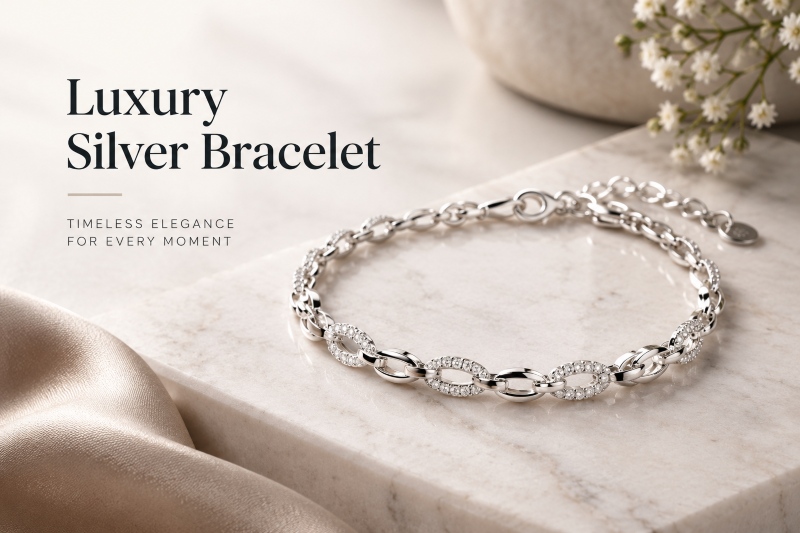
What is a silver bracelet? A silver bracelet is a bracelet made from solid silver or a silver alloy, most often 925 sterling silver: 92.5% silver mixed with 7.5% other metals, usually copper. It comes in many styles, including chain, bangle, cuff, charm, beaded and slider bracelets. A bracelet that is only silver-coloured or silver-plated is not a true silver bracelet, even if it’s sold as “silver”.
That last point catches out a lot of buyers. The word “silver” is used loosely online, and the price difference between solid sterling and plated base metal is large. This guide explains what silver bracelets are made of, what the stamps mean in the US and UK, which styles and clasps suit which wrists, what a fair price looks like, and how to check whether yours is real.
Silver bracelets at a glance
- Most common metal: 925 sterling silver (92.5% silver)
- Purest metal: 999 fine silver (too soft for most bracelets)
- Stamps to look for: 925, Sterling, Ster, 999, 958, or a UK hallmark with a lion or Britannia figure
- Tarnishes? Yes, sterling tarnishes naturally. Tarnish is cleanable and doesn’t mean it’s fake
- Good for sensitive skin? Usually, if it’s solid sterling and not plated base metal
- Worth money? Yes, solid silver has metal value, but much less than gold
What is a silver bracelet made of?
Pure silver is beautiful but soft. The Royal Society of Chemistry describes silver as a relatively soft metal and notes that sterling silver contains 92.5% silver, which is why sterling is used for jewellery and tableware. A bracelet takes knocks every day against desks, doors and watch cases, so jewellers add a small amount of harder metal to make it last.
Here are the silver grades you’ll see on bracelets:
| Grade | Silver content | Stamp | What it’s like on a bracelet |
|---|---|---|---|
| Fine silver | 99.9% | 999, FS | Bright and soft; bends and scratches easily. Best for simple, light designs |
| Britannia silver | 95.8% | 958, Britannia mark (UK) | Softer than sterling; used by some UK makers |
| Argentium silver | 93.5% or 96% | 935, 960 | A modern sterling alternative with germanium; more tarnish-resistant |
| Sterling silver | 92.5% | 925, Sterling, Ster | The everyday standard; strong enough for chains, bangles and cuffs |
| Coin silver | 90% | 900, Coin | Found on antique and vintage pieces |
| 800 silver | 80% | 800 | Common on older European silver |
For most people, 925 sterling is the right choice. It’s hard enough for daily wear, holds stones and clasps securely, and can be repaired, resized and polished for decades.
Solid silver vs silver-plated vs “silver-tone”
This is the most important difference to understand before you buy.
- Solid sterling silver: The whole bracelet is 925 silver alloy. It keeps its metal value and can be polished back to bright.
- Silver-plated: A thin layer of silver over brass, copper or another base metal. The plating wears off with use, often first at the clasp and on the inside of links.
- Silver-tone or silver-colour: No silver at all. Usually stainless steel, zinc alloy or base metal with a silver-looking finish.
- Rhodium-plated sterling: Solid sterling with a thin rhodium coating. It looks brighter and resists tarnish for a while, but the coating wears off over time.
- Gold vermeil or gold-plated silver: Sterling with a gold layer on top. It’s still a silver bracelet underneath.
In the UK, the government’s guidance on gold-plated silver says these pieces are hallmarked as silver, and sellers must describe them clearly, for example as “18ct gold plated silver”.
What do the stamps on a silver bracelet mean?
In the United States: The Federal Trade Commission’s Jewelry Guides (16 CFR Part 23) say a product should contain at least 925 parts per thousand silver before it’s called “sterling silver”, “sterling”, “ster” or “solid silver”. When the FTC revised the Guides in 2018, it kept that 925 threshold and reserved “coin silver” for products that are 900 parts per thousand.
In the United Kingdom: Silver sold as silver must be hallmarked by an independent Assay Office, unless it’s very light. The UK hallmarking guidance notes published on GOV.UK set the exemption weight for silver at 7.78 grams. This comes from the Hallmarking (Exempted Articles) Order 1982. So a thin chain bracelet under 7.78 g may only carry a “925” stamp, while heavier bangles and cuffs should carry a full hallmark.
A full UK hallmark usually includes:
- Sponsor’s mark: the initials of the maker or importer
- Fineness mark: a number such as 925 or 958
- Assay Office mark: London, Birmingham, Sheffield or Edinburgh
- Optional traditional marks: the lion passant for sterling, or the Britannia figure
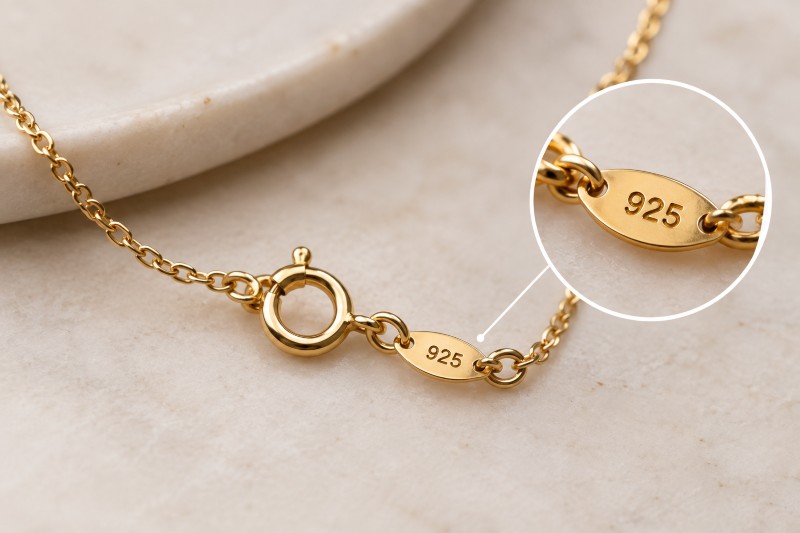
Where to look: Check the clasp, the tag next to the clasp, the inside of a bangle or cuff, or the back of a charm. You may need a magnifying glass or your phone’s camera zoom.
A stamp is a strong sign, but it isn’t proof on its own, because counterfeit pieces can be stamped too. The tests further down help you double-check.
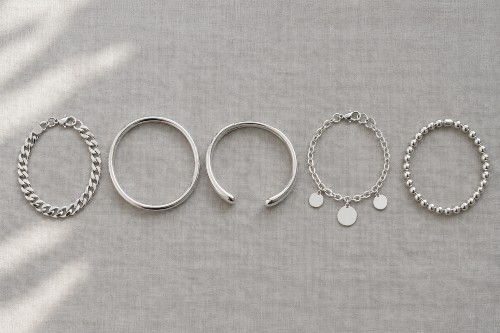
Types of silver bracelets
The style you choose affects comfort, sizing, how often you’ll clean it, and how well it suits your wrist.
| Style | What it is | Best for |
|---|---|---|
| Chain / link | Linked metal (curb, figaro, rope, box, paperclip, Byzantine) | Everyday wear; easy to size; good gifts |
| Bangle | A solid ring with no clasp that slips over the hand | Stacking; a neat, minimal look |
| Cuff | A rigid band with an open gap | Bold statement pieces; slight adjustability |
| Charm | A sturdy chain with hanging charms | Personal gifts and milestones |
| Beaded | Silver beads on wire, cord or elastic | Casual looks; layering with watches |
| Tennis | A row of set stones in a silver frame | Evening and formal wear |
| Slider / bolo | Adjustable with a sliding bead | Gifts when you don’t know the wrist size |
| ID / bar | A flat plate on a chain, often engraved | Personalised gifts; popular with men |
Chain and link bracelets are the most popular. Curb chains lie flat and suit both men and women. Rope and Byzantine chains look richer but trap more dirt between links. Paperclip chains are light and modern.
Bangles have no clasp, so they must fit over the widest part of your hand. Sizing works differently from chains, so read our step-by-step guide on how to measure bangle size before you order.
Cuffs slide on from the side of the wrist. Good sterling cuffs can be gently squeezed or opened a few millimetres, but don’t do this repeatedly or the metal will weaken.
Silver bracelets are especially popular with men, because silver suits cool tones, denim and watches. If you’re buying for a man, see our guide on whether men wear bracelets and how to style them.
Silver bracelet clasps
The clasp decides how secure your bracelet is and how easy it is to put on alone.
| Clasp | Security | Ease of use | Notes |
|---|---|---|---|
| Lobster claw | High | Medium | The most common and reliable for chains |
| Spring ring | Medium | Hard alone | Small and light; common on fine chains |
| Box clasp | High | Medium | Often has a safety catch; used on heavier bracelets |
| Toggle | Medium | Easy | Decorative; can open on loose fits |
| Magnetic | Low to medium | Very easy | Good for limited hand mobility; avoid on valuable pieces |
If you’ll wear the bracelet every day, choose a lobster or box clasp. If you struggle with small clasps, a slider bracelet or a cuff avoids the problem completely.
How to choose the right silver bracelet
1. Measure your wrist. Wrap a soft tape or a strip of paper around your wrist bone, where a bracelet sits. Then add room for comfort:
| Fit | Add to wrist measurement | Feels like |
|---|---|---|
| Snug | 1.3 cm (0.5 in) | Stays in place; little movement |
| Comfort | 1.9 cm (0.75 in) | Slight drape; the most popular fit |
| Loose | 2.5 cm (1 in) | Hangs toward the hand |
Chunky links take up more space inside the bracelet, so add a little extra for wide chains.
2. Match the weight to your wrist. Fine chains (2–4 mm) suit slim wrists and stacking. Wider curbs and cuffs (6 mm and up) suit larger wrists and statement looks.
3. Think about your day. If you type or work with your hands, avoid dangling charms and large cuffs that knock against surfaces.
4. Check the metal. Look for 925 or a hallmark, and ask the seller in writing whether the piece is solid or plated.
5. Decide if you want it on forever. Some people now choose welded, clasp-free bracelets. Sterling is a common choice for these; see our guide to permanent jewelry for how it works and what it costs.
Silver vs gold vs stainless steel bracelets
| Sterling silver | 14K gold | Stainless steel | |
|---|---|---|---|
| Precious metal | Yes | Yes | No |
| Tarnishes | Yes, cleanable | Very little | No |
| Typical price | Low to medium | High | Low |
| Metal value when sold | Low to moderate | High | None |
| Weight | Medium | Heavy | Medium |
| Repairs and resizing | Easy | Easy | Difficult |
Silver gives you real precious metal at a fraction of gold’s price. Gold holds far more value per gram, which our 14K gold bracelet value guide explains with a weight-based price table.
How much is a silver bracelet worth?
A silver bracelet’s price has two parts: the metal and everything else (design, brand, labour, stones).
To estimate the metal value of a sterling bracelet:
Metal value = weight in grams × 0.925 × today’s silver price per gram
For example, a 20 g sterling cuff contains about 18.5 g of pure silver. Multiply that by the day’s silver price per gram to get its melt value. Silver prices change daily, so check a live price before selling.
Buyers rarely pay full melt value. Expect less from pawn shops and more from specialist precious-metal buyers. Designer pieces, antique pieces with clear hallmarks, and bracelets with gemstones can sell for well above melt value. For background on silver as a traded precious metal, the USGS silver commodity profile explains where silver comes from and how it’s used.
Is a silver bracelet good for sensitive skin?
Usually, yes. Nickel is one of the most common causes of skin reactions to jewellery. The American Academy of Dermatology lists pure sterling silver among the metals people with a nickel allergy can usually wear.
The risk comes from cheap “silver” bracelets made of base metal with a thin plating. Once the plating wears through, nickel or copper touches your skin. Mayo Clinic explains that nickel allergy usually causes an itchy rash where the metal touches the skin, and that avoiding long contact with nickel is the best prevention.
If a bracelet leaves your wrist red, itchy or blistered, stop wearing it and see a doctor if the rash doesn’t clear.
Do silver bracelets have health benefits?
Some jewellery sellers claim silver bracelets improve circulation, balance body temperature or block radiation. There’s no reliable evidence for these claims.
What is true: silver compounds and silver nanoparticles do have antibacterial properties, which is why they’re used in some wound dressings and odour-resistant fabrics, as the Royal Society of Chemistry notes. That doesn’t mean wearing a bracelet treats or prevents illness. Wear a silver bracelet because you like it, not as a health product.
How to tell if a silver bracelet is real
No single home test is proof. Use several together, and see a jeweller for anything valuable.
- Find the stamp or hallmark. Look for 925, Sterling, Ster, 999 or a UK hallmark. Missing marks on a heavy piece are a warning sign.
- Use a strong magnet. Silver isn’t magnetic. If the links jump to a neodymium magnet, the core is iron, nickel or steel. A tiny pull at the clasp may just be its steel spring.
- Check worn spots. Look closely at the clasp and inside the links. Yellow, red or grey metal showing through means plating.
- Do the white cloth test. Rub an unpolished area with a white cloth. Real silver that has tarnished leaves a grey or black mark.
- Notice the weight. Solid silver feels heavier than aluminium or zinc alloy of the same size.
- Get a professional test. A jeweller can do an acid test or a non-destructive XRF scan in minutes.
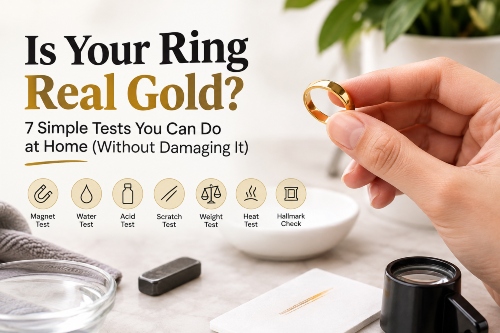
The same logic applies to gold. See our guides to telling if a necklace is real gold and telling if a ring is real gold.
Why silver bracelets tarnish
Tarnish is a thin dark layer of silver sulfide. It forms when the silver and copper in sterling react with sulfur compounds in the air, in sweat and in some cosmetics. Tarnish usually turns silver yellowish first, then brown, then black.
Tarnish does not mean your bracelet is fake. In fact, real sterling tarnishes, while stainless steel and many plated pieces don’t.
Things that speed up tarnish:
- Humid air and air pollution
- Lotion, perfume, sunscreen and hairspray
- Chlorinated pools, hot tubs and sea water
- Rubber bands, wool and some cardboard packaging
- Leaving the bracelet in a steamy bathroom
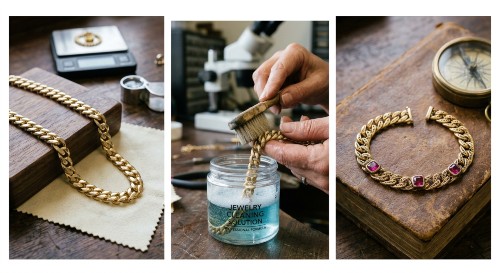
How to clean a silver bracelet at home
Method 1: Soap and water (light dirt and dullness)
- Add a few drops of mild dish soap to a bowl of warm water.
- Soak the bracelet for 5–10 minutes.
- Brush gently with a soft toothbrush, paying attention to links and the clasp.
- Rinse under clean water.
- Dry completely with a lint-free cloth.
Method 2: Aluminium foil bath (heavier tarnish, plain silver only)
- Line a glass bowl with aluminium foil, shiny side up.
- Add hot water, about a tablespoon of baking soda and a little salt.
- Lay the bracelet on the foil so it touches it.
- Leave it for a few minutes until the tarnish lifts.
- Rinse well and dry thoroughly.
The Chicago Section of the American Chemical Society explains the chemistry: the reaction turns silver sulfide back into silver, so you remove tarnish without scrubbing away metal.
Don’t use the foil bath on: pearls, opals, turquoise, amber or other soft stones; oxidised (deliberately darkened) designs, because it removes the dark finish; or rhodium-plated pieces.
For gold pieces, use the gentler method in our guide to cleaning a gold chain at home.
How to store and care for a silver bracelet
- Last on, first off. Put it on after lotion, perfume and hairspray, and take it off before showering, swimming, cleaning or exercising.
- Wipe after wearing. A soft dry cloth removes skin oils before they cause tarnish.
- Store it airtight. A small zip bag or lined box with an anti-tarnish strip slows tarnish a lot.
- Keep pieces apart. Store each bracelet separately so links don’t scratch each other.
- Wear it often. Regular wear and gentle rubbing keep silver brighter than leaving it in a drawer.
How to style a silver bracelet
- Everyday: A single 3–5 mm curb or box chain works with almost anything.
- Stacking: Mix one bangle, one chain and one beaded bracelet of different widths. Keep the metal colour consistent, or mix silver and gold on purpose.
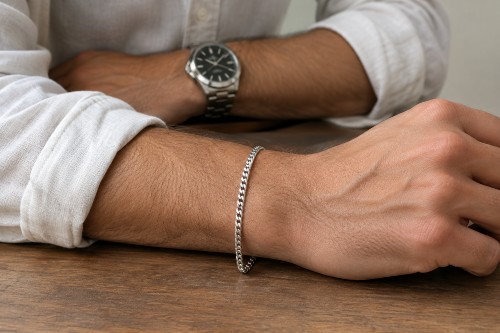
- With a watch: Wear a slim silver bracelet on the same wrist, or a bolder one on the other wrist.
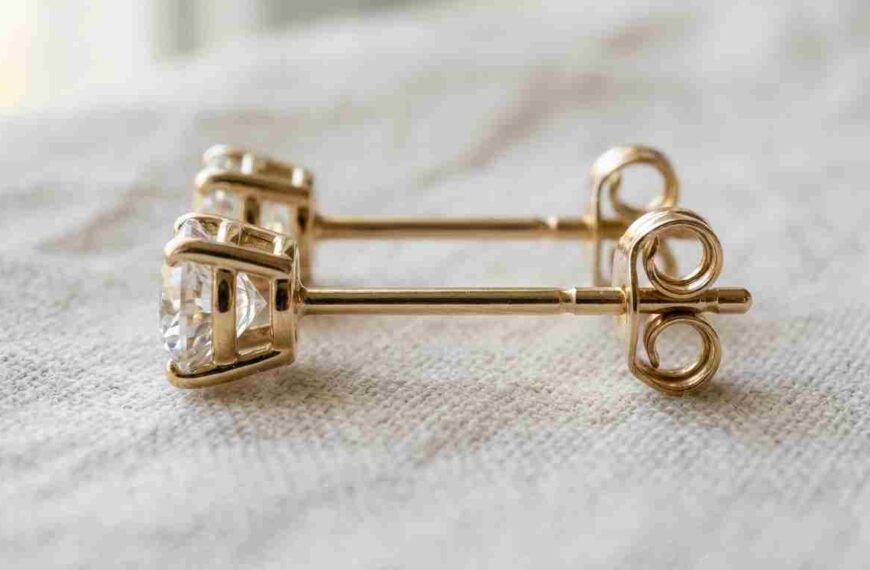
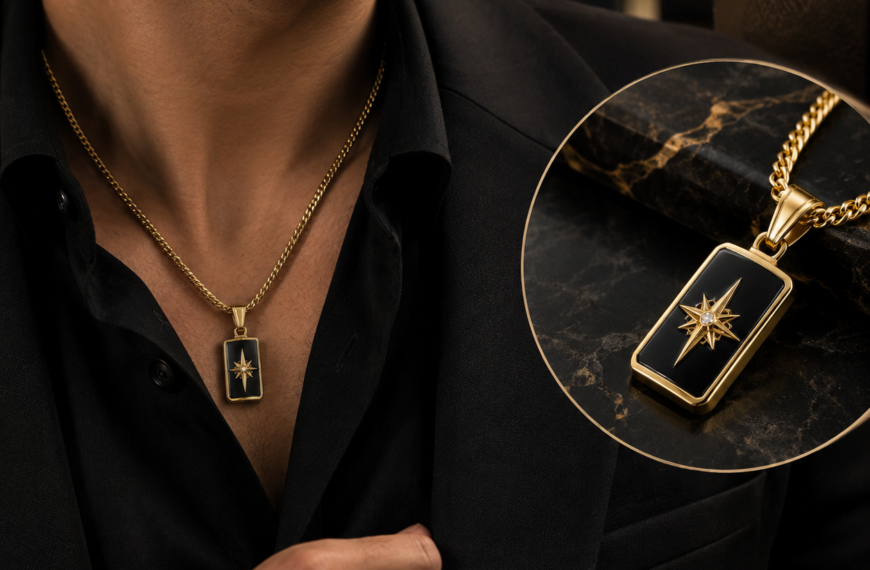
- Matching pieces: Pair it with silver studs; our guide to what post earrings are helps you choose a secure pair. Men can tie the look together with a silver chain and pendant, as shown in can guys wear pendants.
Frequently asked questions
What is the difference between 925 silver and sterling silver? None. Both mean the bracelet is 92.5% silver.
Is a silver bracelet real silver? Only if it’s made of solid silver or a silver alloy. Silver-plated and silver-tone bracelets are not solid silver.
Can I wear a silver bracelet every day? Yes. Take it off for water, chemicals and sleep, and wipe it after wearing.
Can I shower with a silver bracelet? Water won’t ruin sterling, but soap film, hard water and steam dull it and speed up tarnish. It’s better to take it off.
Will a real silver bracelet turn my skin green? Solid sterling rarely does. Green marks usually come from copper or brass under worn plating. Grey marks can come from tarnish on real silver.
Does a silver bracelet need a hallmark? In the UK, silver over 7.78 g sold as silver must be hallmarked. In the US, a “925” or “sterling” mark should only appear on items that meet the 925 standard.
How long does a silver bracelet last? With basic care, a solid sterling bracelet can last a lifetime and be passed down. Plated bracelets usually show wear within months to a few years.
Is a silver bracelet a good gift? Yes. It’s affordable precious metal, suits most styles, and can be engraved. A slider bracelet is safest if you don’t know the wrist size.

 By