
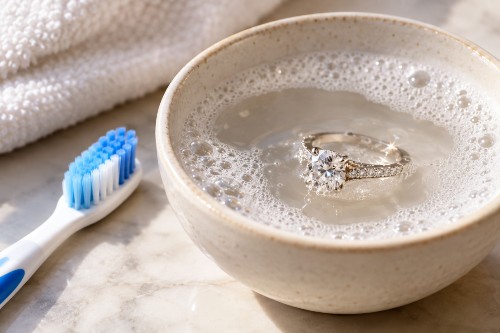
How do you clean a diamond ring? Soak the ring in warm water with a few drops of mild dish soap for 20–30 minutes, gently brush around and under the diamond with a soft toothbrush, rinse under warm running water (with the drain closed), and pat dry with a lint-free cloth. This simple method is safe for nearly all diamond rings and removes the oil and lotion film that makes diamonds look dull.
A diamond can lose much of its sparkle in just a few days of normal wear. The good news is that you don’t need special products to bring it back. This guide walks you through the safest home method, explains what to avoid, shows how to adjust for different settings and metals, and tells you when a jeweler should take over.
Why do diamond rings get dirty so quickly?
Diamonds attract oil. Hand cream, soap, sunscreen, makeup, cooking oil and the natural oils in your skin all cling to the stone and build up as a thin film. That film blocks light from entering and bouncing back out of the diamond, which is what creates sparkle, so even a high-quality diamond can look cloudy.
Most of the buildup collects where you can’t see it: on the underside of the diamond (the pavilion), behind the prongs, and in the gallery beneath the stone. That’s why a quick wipe of the top rarely restores the full sparkle. The Gemological Institute of America’s guide to keeping your diamond sparkling recommends cleaning diamonds regularly for exactly this reason.
What do you need to clean a diamond ring?
You probably already have everything you need in your kitchen or bathroom. Start with a small bowl, warm water (never boiling) and a few drops of plain, mild dish soap, ideally one without bleach, citrus extracts or heavy moisturizers, which can leave a film of their own. Add a new, soft toothbrush or baby toothbrush that you keep only for jewelry, a lint-free microfiber cloth for drying, and either a small strainer or a sink stopper so the ring can’t slip down the drain while you rinse it.
How to clean a diamond ring at home, step by step
This is the safest routine for most diamond rings set in gold or platinum, and it takes less than an hour, most of which is simply waiting.
Begin by filling a small bowl with warm water and adding a few drops of mild dish soap, then swirl it gently until the water is lightly sudsy. Place the ring in the bowl and let it soak for 20 to 30 minutes, or up to an hour if it’s especially grimy. The soak is the most important step, because it softens dried lotion and grease so that you need very little scrubbing afterward.
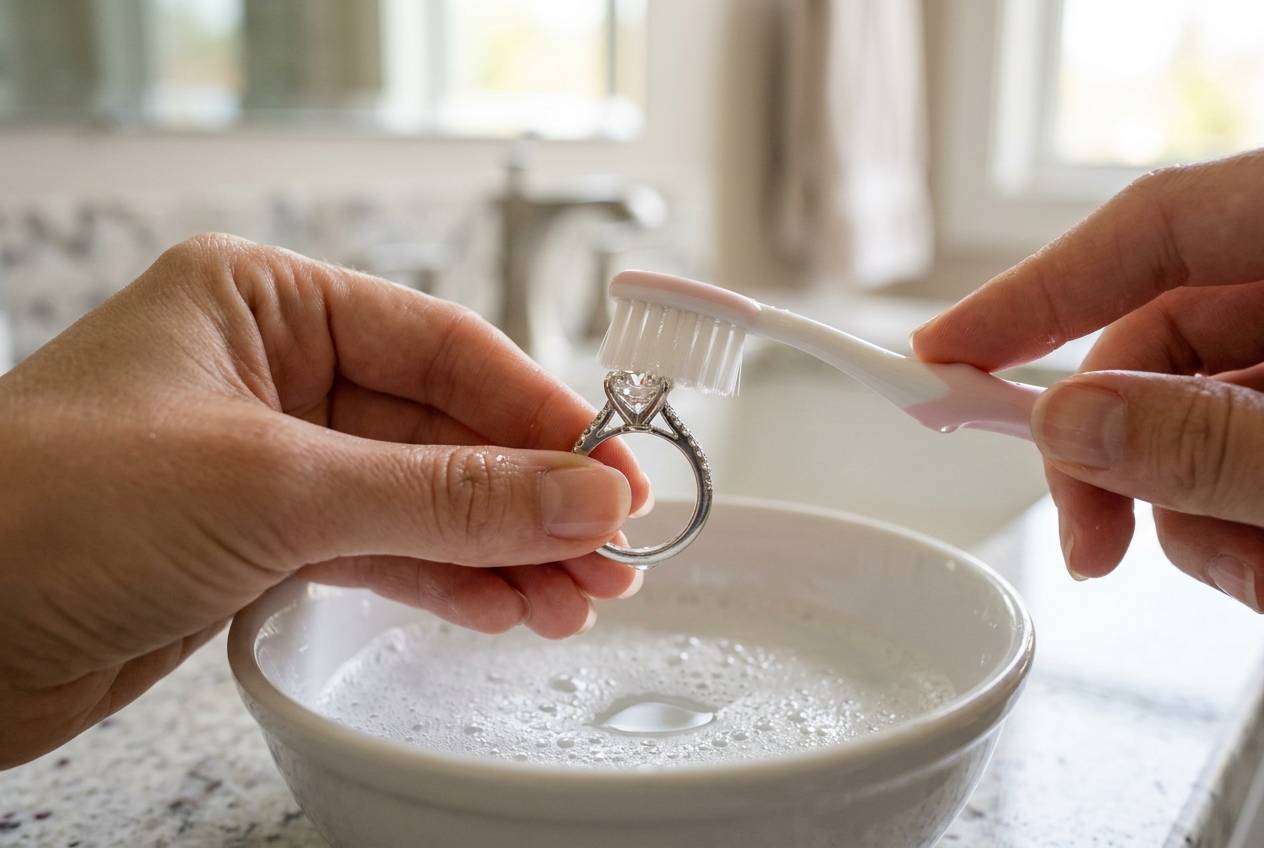
When the time is up, lift the ring out and hold it by the band. Brush gently around the diamond, underneath it and between each prong with the soft toothbrush, using light strokes rather than pressure. Most of the dirt hides on the underside of the stone, so spend a little extra time there.
Next, close the sink drain or hold the ring over a strainer, and rinse it under warm running water until no soap remains. This matters more than people think, because leftover soap film dulls a diamond almost as much as the original dirt. Pat the ring dry with a lint-free microfiber cloth rather than a paper towel or tissue, both of which leave tiny fibers caught in the prongs.
Finally, while the ring is clean and easy to see, take a moment to look closely at the prongs and gently tap the diamond with a fingernail. If the stone moves, sits crooked or makes a faint rattle, take the ring to a jeweler before you wear it again.
GIA’s advice matches this routine: use a soft, clean toothbrush to remove remaining dirt, then rinse and dry with a soft, lint-free cloth.
Which diamond ring cleaning methods are safe?
Not every cleaning method suits every ring. Use this table to choose.
| Method | How it works | Safe for most diamond rings? | Watch out for |
|---|---|---|---|
| Warm water + mild dish soap | Soak, brush, rinse | Yes, the safest choice | Rinse well so soap film doesn’t remain |
| Commercial jewelry cleaner | Ready-made solution | Usually | Check the label; some aren’t safe for pearls or soft stones |
| Jewelry polishing cloth | Wipes oils from metal and stone | Yes, for quick touch-ups | Doesn’t clean under the stone |
| Ultrasonic cleaner | Sound waves shake dirt loose | Often, with caution | Fracture-filled or heavily included diamonds, pavé, soft stones |
| Professional steam cleaning | High-pressure steam lifts grime | Yes, done by a jeweler | Not for heat-sensitive stones |
| Rubbing alcohol or vodka | Dissolves oils | Occasionally, on solid gold or platinum | Can dull some finishes and harm porous stones |
What should you never use to clean a diamond ring?
The diamond itself is very hard, but the metal setting and any other stones are not. These popular “hacks” can cause real damage:
| Avoid | Why |
|---|---|
| Toothpaste | Abrasive; scratches gold, platinum and softer side stones |
| Baking soda paste | Too abrasive for polished metal |
| Chlorine bleach and pool water | Can weaken gold alloys over time and harm prongs |
| Acetone and harsh solvents | Can damage some finishes and treated stones |
| Boiling water | Sudden heat can stress settings and included stones |
| Hard-bristle brushes and scouring pads | Scratch metal; can loosen small stones |
| Paper towels and tissues | Leave fibers in the prongs |
If you swim regularly, take your ring off first. Chlorine is one of the most common causes of damaged prongs in rings worn every day.
Can you use an ultrasonic cleaner on a diamond ring?
Often yes, but not always. Ultrasonic cleaners use high-frequency vibrations in a liquid bath to shake dirt loose from places a brush can’t reach. GIA’s guide to gems and ultrasonic cleaners warns against using them on gems with filled surface-reaching breaks. It notes that diamonds can be fracture-filled with a glass-like substance, and that the filling can be damaged if left in an ultrasonic cleaner too long.
GIA’s diamond care advice adds that you should proceed cautiously if a diamond has feathers or many inclusions. Check your grading report first, because it discloses detectable treatments.
In practice, that means skipping the ultrasonic cleaner if your diamond is fracture-filled or otherwise treated, or if it has a low clarity grade with many inclusions. The same goes for rings with pavé, micro-pavé or tension settings, where tiny stones or the stone itself are held by pressure, and for any ring that also carries soft or organic gems such as emerald, opal, pearl or turquoise. If you can already see a loose stone or a worn prong, the vibrations may finish the job and free the stone entirely.
When in doubt, let a jeweler decide.
How do you know if your diamond has been treated?
Some diamonds are treated to improve their appearance, such as fracture filling or laser drilling, and these need gentler cleaning. In the US, the FTC’s Jewelry Guides, §23.14, say sellers should disclose diamond treatments that aren’t permanent or that create special care requirements. Look for treatment information on your receipt or grading report, or ask the jeweler who sold the ring.
GIA’s 4Cs guide explains clarity grades, from Flawless to I3. A diamond with lower clarity and more inclusions is the one to clean most gently.
How should you clean different ring settings?
The setting matters as much as the stone.
| Setting | How to clean it | Extra care |
|---|---|---|
| Prong / solitaire | Soak, then brush under the stone and around each prong | Check prongs for bending or wear |
| Halo | Soak longer; brush lightly around the small stones | Small stones loosen more easily |
| Pavé / micro-pavé | Soak; use only the softest brush with very light strokes | Avoid ultrasonic cleaners |
| Bezel | Soak; brush the edge where metal meets stone | Dirt can collect under the rim |
| Channel | Soak; brush along the channel walls | Grime builds up between stones |
| Tension | Soak and rinse; minimal brushing | Avoid ultrasonic cleaners and impacts |
| Closed-back | Soak and rinse thoroughly | Trapped dirt may need professional steam |
Does the metal change how you clean the ring?
Yes. The diamond can handle almost anything, but the band can’t.
Yellow and rose gold. Mild soap and water are ideal. Avoid chlorine and abrasives, which can scratch and weaken the alloy. Make sure your ring is solid gold rather than plated with our guide on how to tell if a ring is real gold.
White gold. Most white gold is coated with rhodium for a bright white finish. The FTC’s Jewelry Guides, §23.7, address disclosure of rhodium surface layers, because the coating wears over time. Harsh chemicals and abrasive pastes speed that up and reveal a slightly yellow tone underneath. A jeweler can re-plate it.
Platinum. Strong and naturally white, so there’s no plating to wear off. It does scratch, though scratches move the metal rather than remove it. Gentle soaking keeps it bright.
Sterling silver. Less common for diamond rings, and it tarnishes. Use a silver polishing cloth on the metal, keep the diamond area clean with soap and water, and avoid silver dips around stones. Our guide to sterling silver jewelry explains tarnish and storage.
If your skin reacts to a white gold ring, the alloy may contain nickel. The American Academy of Dermatology lists nickel among the most common causes of skin reactions to jewelry.
Do lab-grown diamonds need different cleaning?
No. Lab-grown diamonds have the same hardness and chemistry as mined diamonds, so the same soap-and-water method works. What matters is the setting, the metal and whether any stones are treated.
How often should you clean a diamond ring?
The more often you wear it, the more often it needs a quick clean.
| Cleaning type | How often | Who does it |
|---|---|---|
| Quick wipe with a polishing cloth | Every few days | You |
| Soap-and-water soak | Every 1–2 weeks | You |
| Close look at the prongs and stone | Monthly | You |
| Professional clean and inspection | Every 6–12 months | A jeweler |
Many jewelers clean and inspect rings for free or for a small fee, especially if you bought the ring from them.
When should a jeweler clean your ring?
Home cleaning keeps your ring bright week to week, but a jeweler can do more. They use steam and ultrasonic equipment to reach deep dirt, and, more importantly, they inspect the prongs under magnification. A worn or bent prong is one of the most common ways a diamond is lost.
It’s time to visit a jeweler when your diamond still looks cloudy after a careful home clean, when a stone moves, rattles or sits at an angle, or when a prong looks bent, flattened or thin. A jeweler is also the right choice for closed-back settings, where dirt can become trapped behind the stone, and whenever you’re not sure whether your diamond has been treated and needs special care.
A professional check also helps when you’re thinking about value. If you’re curious what your band is worth, see how much a 14K gold wedding ring is worth and how much a 14K gold ring is worth.
Why does my diamond still look cloudy after cleaning?
If a diamond stays hazy after a thorough wash, the most common culprit is simply soap residue, so rinse it again under warm running water and dry it with a microfiber cloth. If that doesn’t help, dirt may be trapped beneath a bezel or a closed back where a toothbrush can’t reach, and a jeweler’s steam cleaner will usually clear it.
Sometimes the diamond is clean but the setting isn’t. Scratched, worn metal looks dull and makes the whole ring seem less bright, and a jeweler can polish it back to a shine. In a few cases, the stone itself is the reason: treated or heavily included diamonds can naturally look less brilliant, and your grading report will tell you if that applies.
How do you keep a diamond ring cleaner for longer?
A few small daily habits make a big difference. Get into the routine of putting your ring on last, after lotion, sunscreen, perfume, hairspray and makeup have dried, since beauty products are the main reason diamonds turn cloudy. Take the ring off for messy jobs such as cooking, baking, gardening, cleaning and working out, and try to hold it by the band rather than the stone so your fingertips don’t leave oil on the diamond.
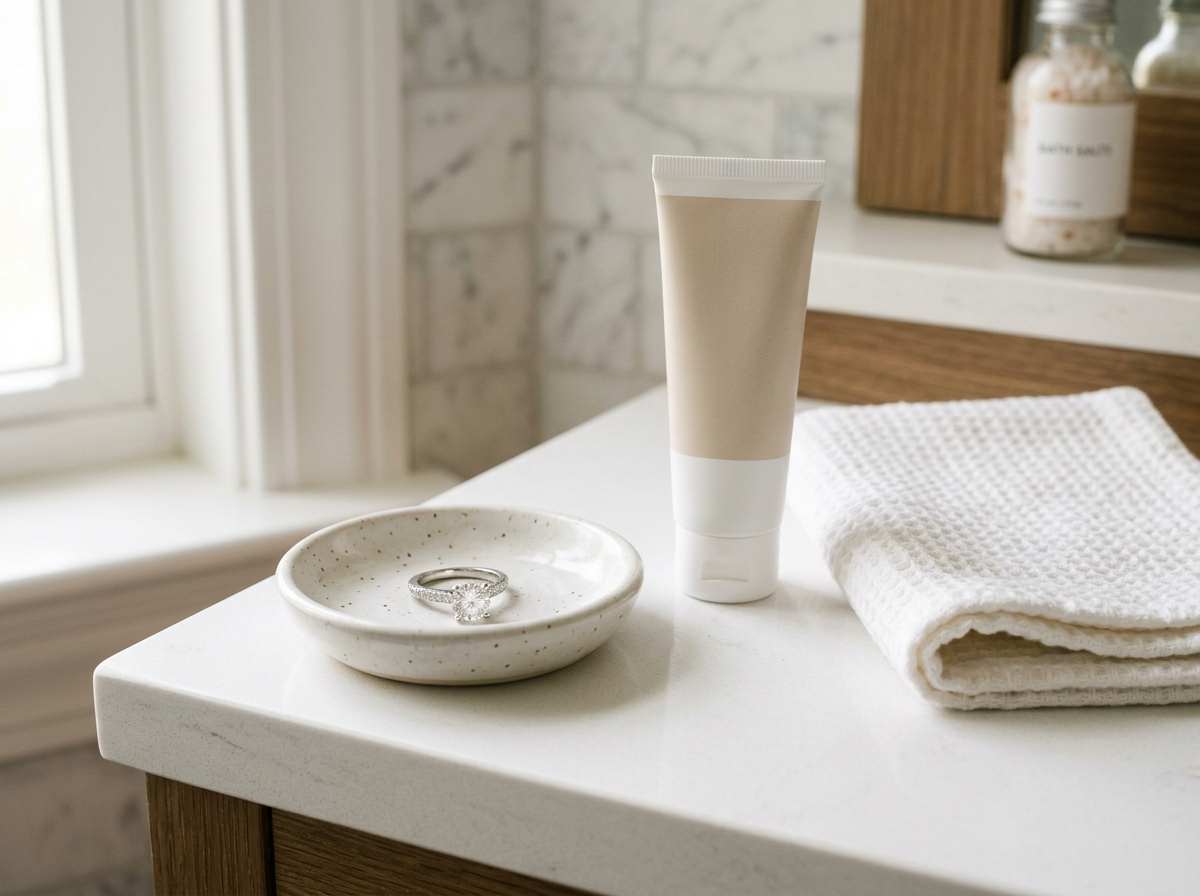
Where you put the ring matters too. A small ring dish by the sink and another by the bed means it never ends up balanced on the edge of a basin. When you’re not wearing it, store it on its own in a soft pouch or lined box, because a diamond can easily scratch other jewelry and even other diamonds.
Cleaning other diamond jewelry
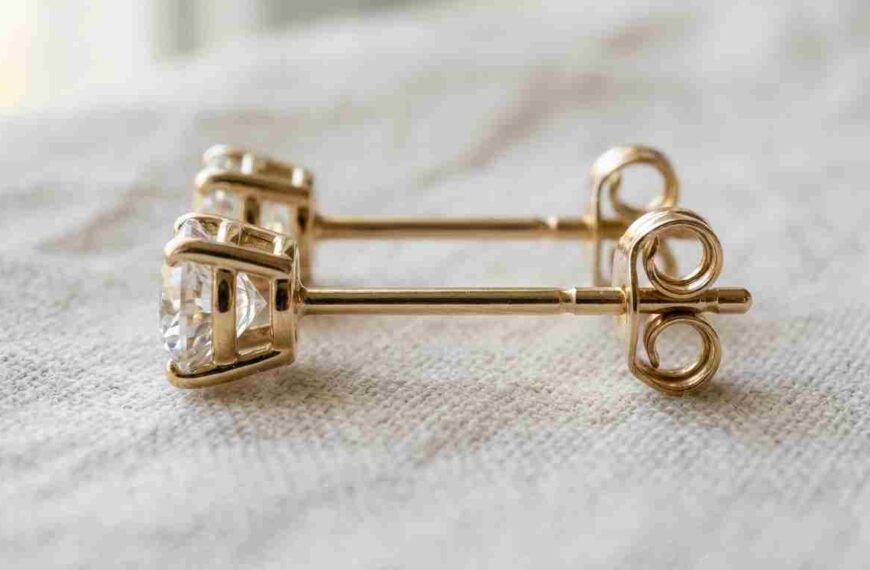
The same gentle method works for most diamond pieces. For studs, where dirt builds up behind the stone and around the post, follow our guide on how to clean diamond earrings. For gold chains and pendants, use the steps in how to clean a gold chain at home.
If your ring is an engagement ring or promise ring you’ll wear every day, our guides to promise rings vs engagement rings and which finger a promise ring is worn on cover fit and daily wear.
Frequently asked questions
What is the best way to clean a diamond ring at home? Soak it in warm water with mild dish soap for 20–30 minutes, brush gently with a soft toothbrush, rinse and dry with a lint-free cloth.
Can I clean my diamond ring with toothpaste? No. Toothpaste is abrasive and scratches gold, platinum and softer stones.
Can I use vinegar or baking soda? It’s better not to. Baking soda is abrasive, and acidic vinegar can harm some metals and stones over time.
Can I use Windex or ammonia? Some jewelers use mild ammonia-based jewelry cleaners on diamonds in gold or platinum, but they aren’t safe for pearls, opals or many other stones. Plain soap and water is the safest choice.
Is it safe to clean an engagement ring with an ultrasonic cleaner? Usually, for a solid diamond in a secure prong setting. Avoid it for fracture-filled diamonds, heavily included stones, pavé settings and soft gems.
How long should I soak my diamond ring? About 20–30 minutes, or up to an hour if it’s very dirty.
Can I sleep or shower with my diamond ring on? It’s better not to. Soap film dulls the diamond, and sleeping in a tall setting can bend prongs.
How often should my ring be checked by a jeweler? Every 6–12 months for a ring you wear daily.

 By