
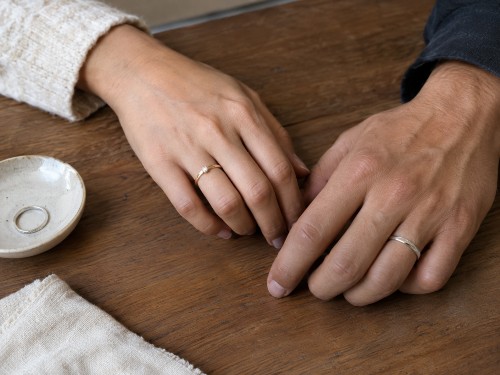
What finger is a promise ring worn on? A promise ring is most often worn on the ring finger (the fourth finger). Wear it on your left ring finger if it’s a step toward engagement. Wear it on your right ring finger if you want it to stay clearly separate from an engagement or wedding ring. There’s no official rule, so any finger that fits well and matches what the ring means to you is the right choice.
This guide explains what each finger says, how culture changes the answer, how to pick your finger in five steps, how to size it correctly, and what to do if the ring spins, pinches, gets stuck or turns your finger green.
Quick answer: which finger should you choose?
| Finger | What it usually says | Best for |
|---|---|---|
| Left ring finger | “We’re serious and may get engaged” | Couples planning a future engagement |
| Right ring finger | “This is a promise, not an engagement” | Avoiding confusion; keeping it after engagement |
| Middle finger | Balanced, no set meaning | Wider bands; friendship or personal promises |
| Index finger | Confidence, independence | Self-promise rings and goals |
| Pinky | Subtle, personal | Slim, delicate bands |
| Thumb | Bold personal style | Wide, comfort-fit bands |
| On a chain | Private, close to the heart | Hands-on jobs; changing finger size |
Should you wear a promise ring on your left or right hand?
Choose the hand based on what you want the ring to say and who will see it. In the US, UK, Canada and Australia, the left ring finger is where engagement rings and wedding bands go, so any ring there gets noticed.
Choose your left hand if:
- The ring is a promise of a future engagement.
- You’re happy to answer “Are you engaged?”
- You plan to move it when the engagement ring arrives.
Choose your right hand if:
- You want no confusion with an engagement ring or wedding band.
- The promise is about friendship, faith, sobriety, health or a personal goal.
- You want to keep wearing it after you get engaged.
- You’re left-handed and want the ring on your less-used hand.
Not sure about the difference between the two rings? Our guide to promise rings vs engagement rings explains the meaning, cost and design of each.
Why is the left ring finger linked to love?
The tradition is real; the anatomy behind it is not. For centuries people repeated the idea of a vena amoris, or “vein of love,” running straight from the left ring finger to the heart. It’s a romantic story, but as fact-checkers at Africa Check explain, veins from every finger return blood to the heart, and which finger carried a wedding ring has always depended on where and when people lived.
Rings themselves have marked love and commitment for a very long time. The British Museum holds a 3rd-century Roman gold ring engraved with the portraits of a couple. Promise rings have a closer ancestor in English posy rings: simple gold bands with a short love motto engraved inside, like the “I Like My Choyse” ring from around 1600 in the Metropolitan Museum of Art. Posy rings weren’t tied to one finger at all.
So you don’t need the vein-of-love story to justify your choice. Pick the finger that fits your promise.
What does each finger mean for a promise ring?
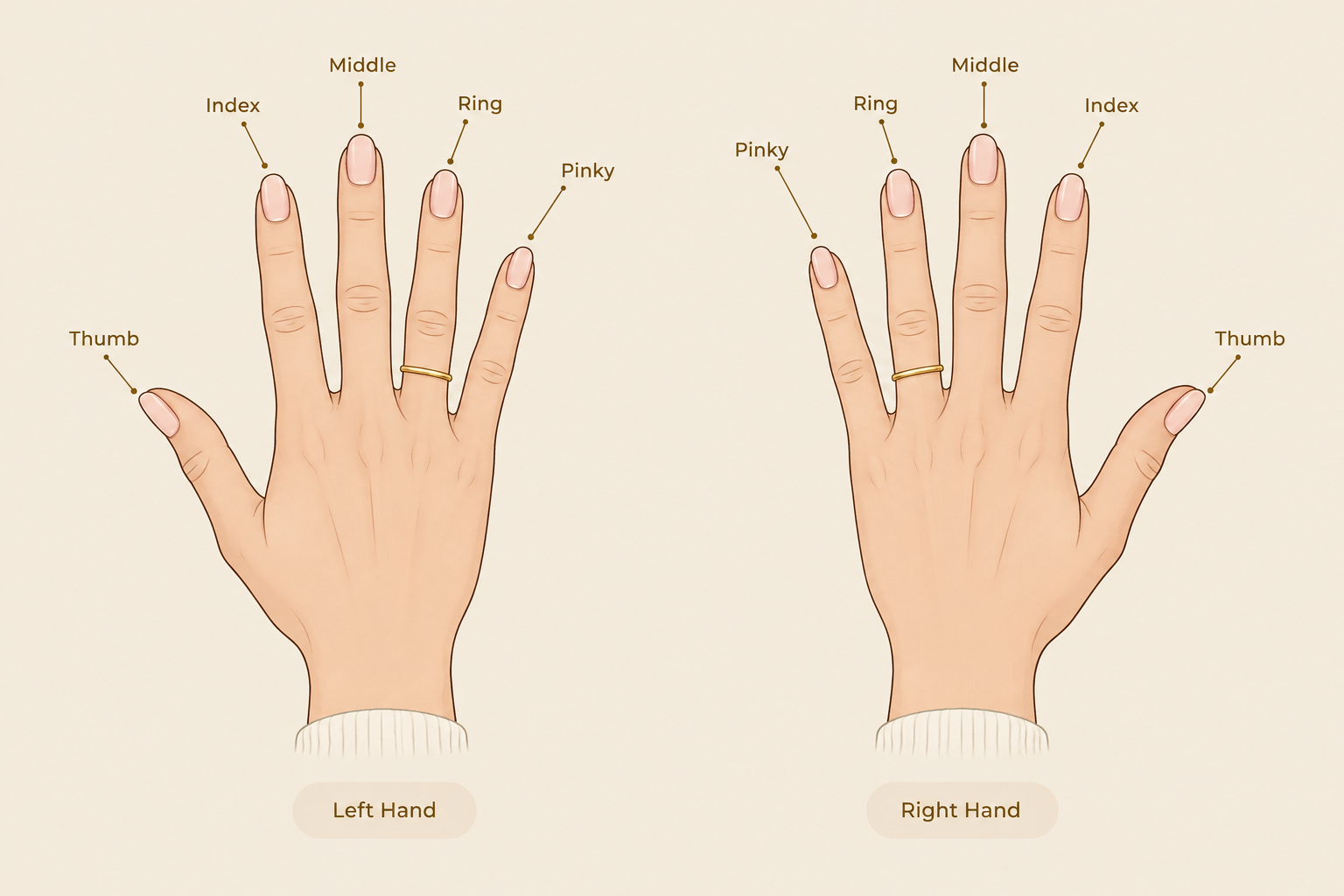
Ring finger (either hand). The most popular and most recognizable choice. On the left, it suggests romance heading toward engagement. On the right, it says “committed” without implying a proposal.
Middle finger. The longest and most central finger, so it suits wider bands and bigger stones. It carries no fixed meaning, which makes it a good choice for friendship rings or matching rings between siblings.
Index finger. Traditionally linked with confidence and leadership. It’s a strong choice for a self-promise ring, such as a commitment to finish a degree, stay sober or reach a health goal.
Pinky. Small, subtle and personal. It’s perfect for thin, dainty bands, but it’s also the finger most likely to bump doors and bags, so choose a sturdy setting.
Thumb. Bold and expressive. The thumb moves constantly, so choose a smooth, rounded comfort-fit band that won’t dig in.
On a necklace. Completely fine, and often the smartest option for nurses, chefs, mechanics, athletes or anyone whose finger size changes. A ring worn on a chain doubles as a pendant; see our guide on whether guys can wear pendants for styling ideas.
Does culture change which finger you should use?
Yes, and it’s worth checking if you live in, travel to, or have family from another country. Wedding ring customs vary:
- Left hand for wedding rings: Common in the US, UK, Canada, Australia, France, Italy and much of Latin America.
- Right hand for wedding rings: Traditional in places including Germany, Poland, Russia, Norway and parts of India.
- Religious and family customs: Some traditions use a different finger during a ceremony and move the ring afterward.
If your community wears wedding bands on the right hand, a promise ring on the right ring finger may look like a wedding band. In that case, the left hand, the middle finger or a necklace may avoid confusion. A short conversation with your partner, and with family if it matters to you, prevents awkward moments.
How do you choose the right finger in 5 steps?
- Decide what the ring means. Talk with your partner. Is it “we’re heading toward engagement,” “we’re exclusive,” or a personal promise? Let the meaning choose the finger.
- Think about who will see it. If you’d rather not answer questions at work or family events, avoid the left ring finger.
- Consider your daily life. Your dominant hand takes more knocks. If you type, cook, lift weights or use tools, wear a stone ring on your less-used hand.
- Measure that exact finger. Your left and right fingers are often different sizes; see the sizing section below.
- Wear it for a week. Notice whether it spins, pinches or catches. If it does, switch fingers or ask a jeweler to adjust it.
Can you wear a promise ring on the same finger as an engagement ring?
Yes, but only if the two rings sit comfortably together. Most couples choose one of these options once they get engaged:
- Move the promise ring to the right ring finger and keep wearing it daily.
- Stack it with the engagement ring on the left ring finger, if the shapes and heights match. Traditionally the wedding band sits closest to the hand, then the engagement ring, then a promise ring on top.
- Wear it on a chain as a necklace.
- Keep it as a keepsake in a ring box.
If you’re planning ahead for wedding bands, see how much a 14K gold wedding ring is worth to set a budget.
Which finger do men wear promise rings on?
Men follow the same rules. Most wear a promise ring on the ring finger of either hand, and many prefer the right hand so it isn’t mistaken for a wedding band. The middle finger and the pinky are also popular for men, especially with wider bands in gold, tungsten or titanium. If he doesn’t like rings, a bracelet works as a promise piece too; see do men wear bracelets. Some couples skip rings entirely and get matching welded bracelets; our guide to permanent jewelry explains how that works.
How do you find the right ring size for your chosen finger?
A ring that fits well is more comfortable, and it’s safer too. Fingers change size through the day, so follow these steps:
- Measure the exact finger you’ll wear it on. Don’t assume the left and right are the same; the dominant hand is often half a size larger.
- Measure late in the day, when your hands are warm and at their largest. Avoid measuring right after a cold shower or first thing in the morning.
- Use a jeweler’s ring sizer if you can. Paper strips and string stretch and give inaccurate results.
- Check the knuckle. The ring should slide over your knuckle with slight resistance and not fall off when you shake your hand gently.
- Size up for wide bands. A band wider than about 6 mm feels tighter, so many people go up a quarter or half size.
- Measure for a surprise gift by borrowing a ring they already wear on that finger and having a jeweler size it.
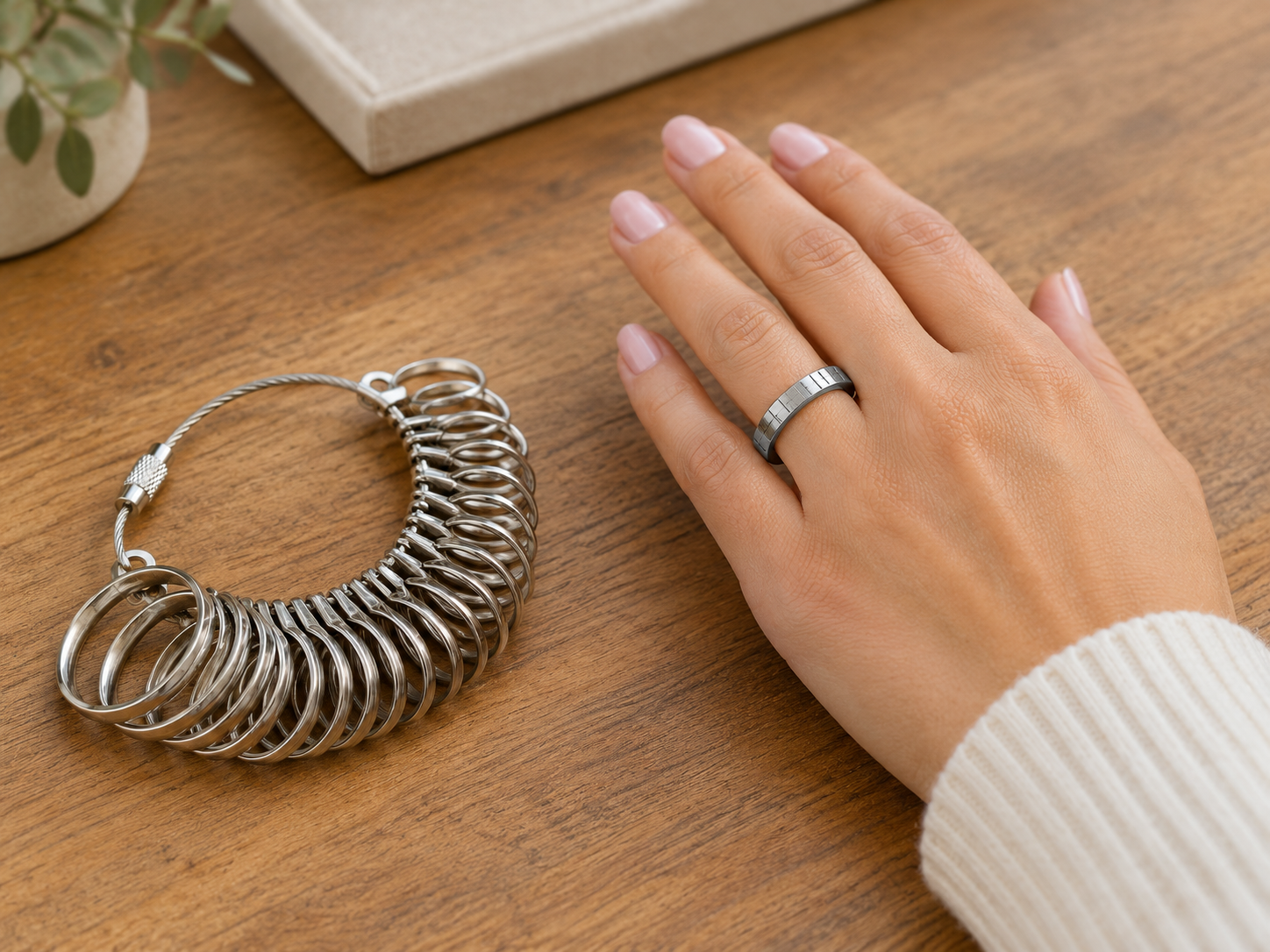
A loose ring isn’t just annoying. Cleveland Clinic notes that the looser a ring fits, the more room it has to catch on something, which can cause a serious finger injury called ring avulsion. It recommends removing rings before working with tools or heavy equipment and before contact sports.
What should you do if your promise ring causes problems?
Most ring problems come from size, metal or daily habits, and most are easy to fix.
The ring gets tight in hot weather. Heat, salty food, flights and long days on your feet make fingers swell. If it’s tight every day, it’s probably too small. If it’s only tight sometimes, a comfort-fit band (rounded inside) helps.
The ring is stuck. Stay calm and don’t yank it. The American Society for Surgery of the Hand recommends this sequence:
- Lubricate the finger and ring with soap, oil or window cleaner.
- Raise your hand above your head for 5–10 minutes with ice around the finger.
- Slide dental floss under the ring, wrap it snugly around the finger up over the knuckle, then unwrap it from the ring end so the ring slides off.
- If nothing works, have it cut off with a ring cutter at a jeweler, fire station or emergency room.
If your finger turns purple, blue, numb or very painful, go to urgent care right away.
The ring spins. It’s loose or top-heavy. A clip-on or adhesive ring guard is a cheap fix, and a jeweler can resize it. Fingers shrink slightly in cold weather, so this often gets worse in winter.
The ring leaves a green or black mark. This is usually harmless. It happens when copper in the alloy, worn plating or tarnished silver reacts with sweat, lotion or soap. Take the ring off before applying hand cream and dry your hands after washing.
Your skin is red or itchy under the ring. This may be a metal allergy, often to nickel. The American Academy of Dermatology recommends nickel-free metals such as platinum and higher-karat gold for people with nickel allergy, and Mayo Clinic notes that a nickel allergy usually lasts for life once it develops.
People keep asking if you’re engaged. Move the ring to your right hand, or keep a simple answer ready: “It’s a promise ring. We’re serious, just not engaged yet.”
Which metal is best for a promise ring you’ll wear every day?
The metal decides how comfortable the ring feels, how well it lasts and whether it irritates your skin.
| Metal | Durability | Tarnish | Good for sensitive skin? | Notes |
|---|---|---|---|---|
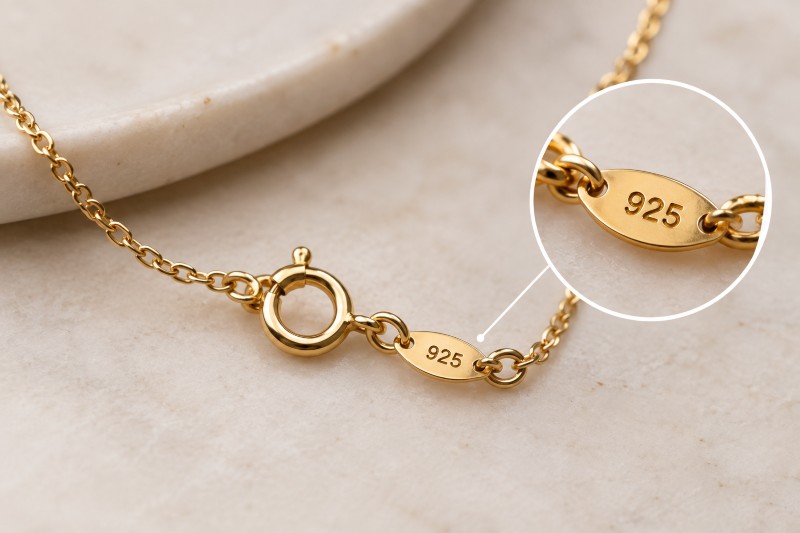
| Sterling silver (925) | Medium | Yes, cleanable | Usually | Affordable; can bend if very thin |
| 10K gold | High | Very low | Usually | 41.7% gold; paler color |
| 14K gold | High | Very low | Usually | 58.3% gold; the most popular balance |
| 18K gold | Medium | None | Yes | 75% gold; softer, scratches more easily |
| Platinum | Very high | None | Yes | Heavy, naturally white, more expensive |
| Gold-plated | Low | Plating wears off | Often not | Avoid for daily wear |
The GIA’s guide to gold karats explains that lower-karat gold is more durable, while higher karats are softer and richer in color. Under the FTC’s Jewelry Guides, gold-plated and gold-filled products must be described as such, so look for the karat stamp (10K, 14K, 585, 18K, 750) inside the band.
Not sure if yours is solid? Use our guide on how to tell if a ring is real gold. To estimate what the metal is worth, see how much a 14K gold ring is worth. For silver rings, our guide on what sterling silver jewelry is made of explains stamps and tarnish care.
How do you care for a promise ring?
Daily habits:
- Take it off for the gym, swimming, cleaning, gardening and cooking.
- Put lotion on first, let it dry, then put the ring back on.
- Keep a small ring dish by the sink so it never goes down the drain.
Weekly clean:
- Soak the ring in warm water with a few drops of mild dish soap for 10–15 minutes.
- Brush gently with a soft toothbrush, especially under any stone.
- Rinse under clean water with the sink drain closed.
- Pat dry with a lint-free cloth.
Avoid toothpaste, bleach and abrasive powders. For stone-safe detail, follow our guide on how to clean a diamond ring. Soft stones like opal, emerald and pearl should never go in an ultrasonic cleaner.
Common mistakes to avoid
- Sizing the wrong finger. Size the exact finger you’ll wear it on.
- Not talking about the meaning. One person thinks “future engagement,” the other thinks “just dating.”
- Choosing a solitaire-style ring as a promise ring. It looks like a proposal on any hand.
- Wearing it loose. It spins, snags and is more likely to cause injury.
- Ignoring skin reactions. Persistent redness or itching usually means the metal needs to change.
Frequently asked questions
What finger is a promise ring worn on? Usually the ring finger. Left suggests a future engagement; right keeps it separate from engagement and wedding rings.
Which hand does a girl wear a promise ring on? Either. Many women wear it on the right ring finger, then move it after getting engaged.
Which hand does a guy wear a promise ring on? Either, often the right hand. The middle finger and pinky are also common for men.
Can you wear a promise ring on your middle finger? Yes. It’s a good choice for wide bands and for friendship or personal promises.
Can a promise ring go on the left ring finger? Yes, especially if it’s a step toward engagement. Expect people to ask if you’re engaged.
Do both partners wear promise rings on the same finger? They can, but they don’t have to. Each person should pick the finger that fits their life and size.
Can I wear my promise ring on a necklace? Yes. It’s a practical option for hands-on jobs, sports or changing finger sizes.
Does the vein of love really exist? No. It’s a romantic old belief. Veins from every finger return blood to the heart.

 By