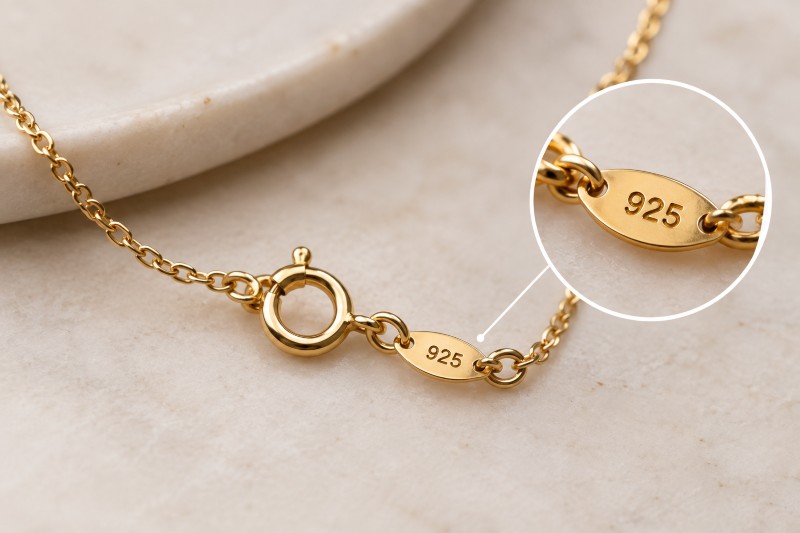

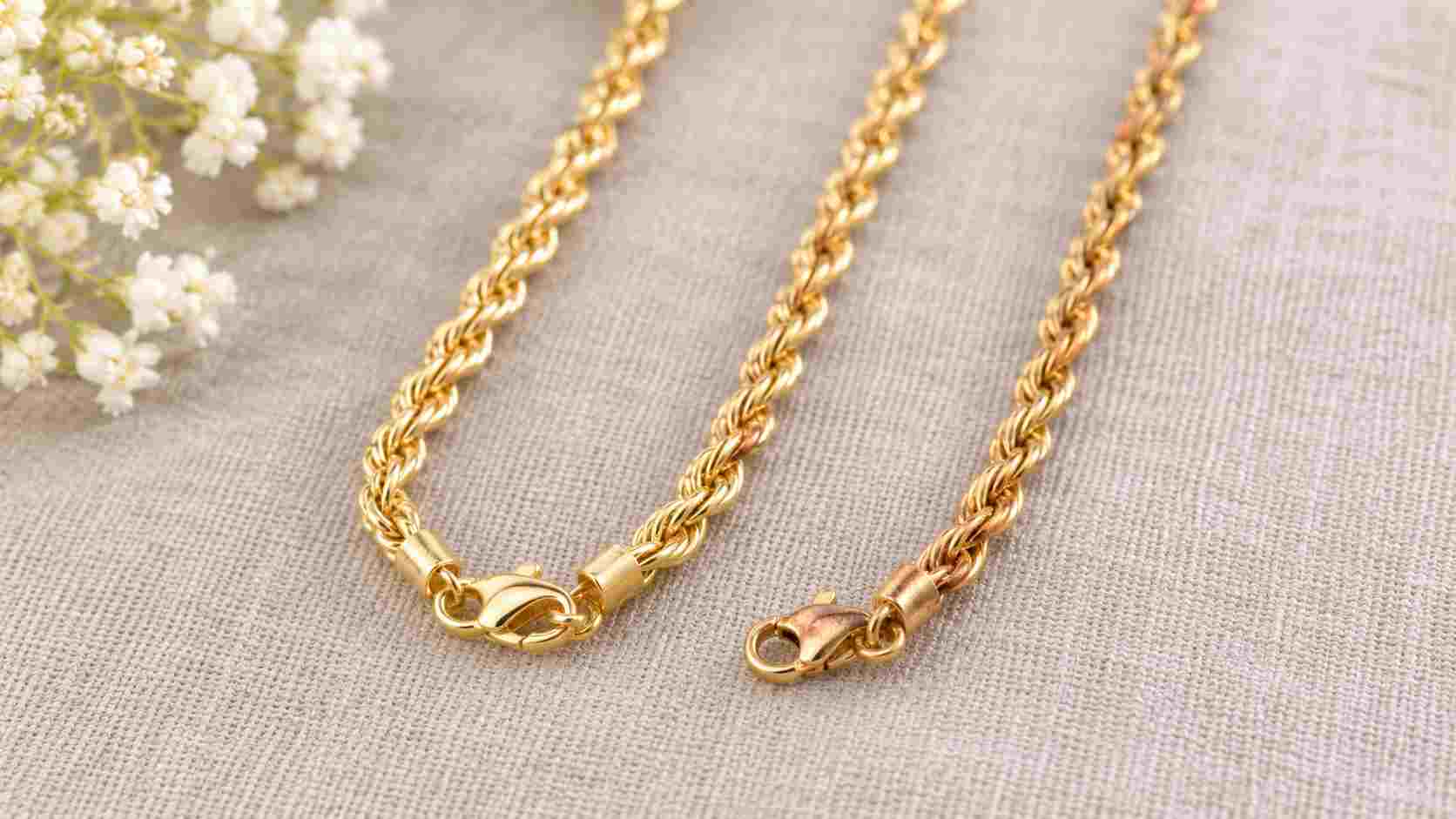
Two gold chains sit side by side in an online shop. They look the same in the photos. One says “gold plated” and the other says “14K gold filled,” and the gold filled one costs noticeably more. Is the difference real, or is it just a label?
The difference is real, and it comes down to how much gold is on the surface and how it got there. When you compare gold filled vs gold plated, gold filled jewelry has a thick layer of real karat gold bonded to a base metal, while gold plated jewelry has a very thin layer of gold deposited onto a base metal. Both have a non-gold core, but gold filled carries far more gold and lasts far longer.
Quick Answer: Gold filled jewelry has a layer of 10K or higher gold that makes up at least 1/20 (5%) of the item’s total metal weight, bonded to a base metal such as brass. Gold plated jewelry has a much thinner gold layer, as little as 0.175 microns under US guidelines, usually applied by electroplating. Is gold filled real gold? The outer layer is real karat gold, but the core is not, so it is not solid gold. Gold filled usually lasts years; gold plating can wear off in months with daily use.
Key Takeaways
- Gold filled = thick karat gold layer that is at least 1/20 of the total metal weight, bonded to a base metal.
- Gold plated = thin gold layer, often about 0.175 microns or more, usually electroplated over brass or copper.
- Is gold filled real gold? The surface is real 10K–14K gold (sometimes 12K or 18K), but the core isn’t.
- Gold filled jewelry typically has many times more gold than plated jewelry of the same size.
- Look for stamps like “1/20 14K GF” or “14/20” for gold filled, and “GP,” “GEP” or “HGE” for plated.
- Gold filled suits everyday chains, bracelets and earrings; plated suits occasional and trend pieces.
What Is Gold Filled Jewelry?
Gold filled jewelry is made by bonding a sheet or tube of karat gold to a base metal core, usually brass, under heat and pressure; under US guidelines, the gold layer must be at least 10 karats and make up at least 1/20 of the total metal weight. The result is a solid layer of gold, not a thin coating, wrapped around the core.
The Federal Trade Commission’s Jewelry Guides set these rules. An item may be marked “gold filled” or “GF” only if it has a layer of at least 10K gold that is mechanically bonded to the base metal and makes up at least one-twentieth of the weight of the metal in the whole item. The mark should also state the karat, such as “1/20 14K Gold Filled.”
The name can be confusing. Gold filled jewelry isn’t “filled” with gold on the inside. It’s the opposite: the gold is on the outside, and the core is another metal. Think of it as a thick gold jacket around a brass center.
How Is Gold Filled Jewelry Made?
Makers fuse a layer of karat gold to a brass core using heat and pressure, then roll or draw the bonded metal into sheet or wire before shaping it into jewelry. Because the gold is bonded before the piece is formed, the gold layer stays relatively thick and even across the surface.
This is a very different process from plating. Plating adds gold to a finished piece by dipping it in a chemical bath. Gold filled metal is made first and then turned into chains, wire, ear wires and beads, which is why gold filled is so common in handmade and wire-wrapped jewelry.
What Do “1/20” and “14/20” Mean?
“1/20” means the gold layer makes up one-twentieth (5%) of the item’s total metal weight, and “14/20” is shorthand for a 1/20 layer of 14K gold. You may also see “12/20,” which means a 1/20 layer of 12K gold.
Here is a simple example. A 10-gram chain marked 1/20 14K GF has about 0.5 grams of 14K gold on its surface. Since 14K gold is 58.3% pure gold, that works out to roughly 0.29 grams of pure gold in the chain. That’s small compared with solid gold, but it’s a lot more gold than a plated chain of the same weight.
Is Gold Filled Real Gold?
Yes, the outer layer of gold filled jewelry is real karat gold, usually 12K or 14K, but the core is a base metal, so gold filled is not solid gold. You’re wearing real gold on the surface, which is why it looks and wears much like solid gold.
That real gold layer is the reason gold filled behaves so well in daily wear. It’s thick enough that normal rubbing takes a long time to wear through it. The core, though, carries very little value. So gold filled jewelry gives you the look and much of the durability of gold at a lower price, but not the full metal value of solid gold.
Is Gold Filled Worth Anything to Sell?
Gold filled jewelry has a small scrap value from its gold layer, but buyers pay much less than for solid gold because only about 5% of the weight is karat gold and refining it costs money [VERIFY]. Many gold buyers either decline gold filled or price it at a small fraction of solid gold.
If resale value matters to you, solid gold is the better choice. Our guides to 14K ring value and 14K bracelet value show how solid gold is priced by weight and purity, which is very different from how gold filled is valued.
What Is Gold Plated Jewelry?
Gold plated jewelry is a base metal piece, often brass or copper, coated with a thin layer of gold, usually by electroplating. In electroplating, a finished piece is placed in a gold solution, and an electric current deposits gold atoms onto the surface.
Under the FTC’s guides, an item marked “gold electroplate” should have a gold layer of at least 10K with a thickness equal to 0.175 microns of fine gold. “Heavy gold electroplate” (often stamped “HGE”) should be equal to at least 2.5 microns. Layers thinner than 0.175 microns may be described as “gold flashed” or “gold washed.” A micron is one-thousandth of a millimeter, so even heavy plating is extremely thin.
In everyday shopping, “gold plated” almost always means electroplated. Plating is the most affordable way to get a gold look, which is why it’s so common in fashion jewelry.
What Is Under Gold Plating?
The metal under gold plating is usually brass, copper or another base metal alloy, and some pieces may contain nickel. Sterling silver can also be plated; when it meets the FTC’s thickness and karat rules, it may be called gold vermeil.
If you want to understand that silver-based option, our guide to gold vermeil explains how it compares with both plated and gold filled pieces.
Gold Filled vs Gold Plated: What’s the Difference?
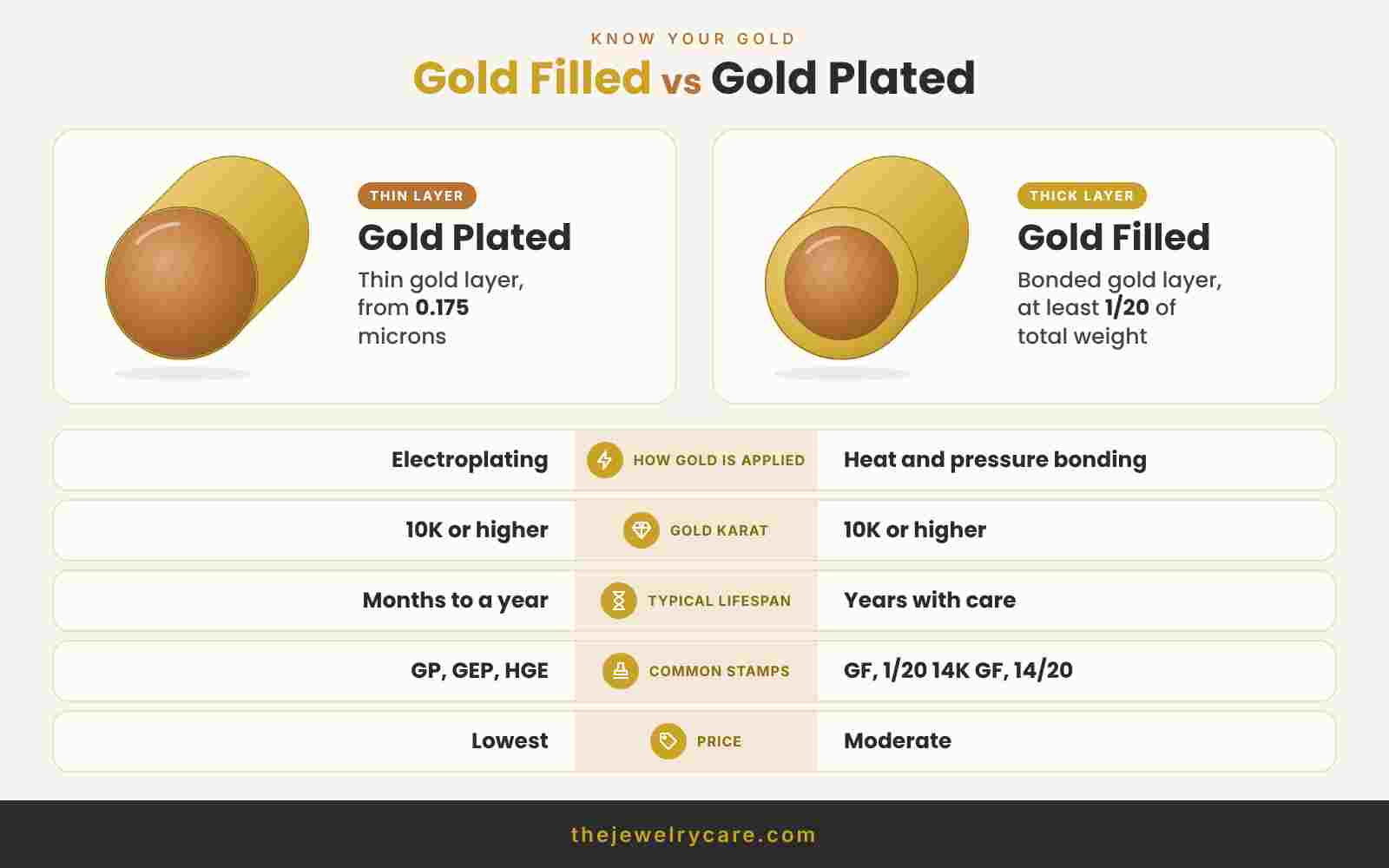
The main difference between gold filled vs gold plated jewelry is the amount of gold: gold filled has a thick, bonded gold layer equal to at least 5% of the metal weight, while gold plated has a thin, electroplated layer that can be as little as 0.175 microns. That single difference affects durability, skin reactions, care and price.
| Feature | Gold filled | Gold plated |
|---|---|---|
| How the gold is applied | Bonded with heat and pressure | Electroplated in a chemical bath |
| Minimum gold (US guides) | At least 1/20 of the total metal weight | At least 0.175 microns thick |
| Gold karat | At least 10K, usually 12K or 14K | At least 10K; often 14K, 18K or 24K color |
| Usual core metal | Brass | Brass, copper or other base metals |
| Typical lifespan | Often 10 years or more with care [VERIFY] | Often a few months to a year with daily wear [VERIFY] |
| Sensitive skin | Usually good while the gold layer is intact | Depends on the base metal once the gold wears |
| Common stamps | GF, 1/20 14K GF, 14/20, 12/20 | GP, GEP, HGE, 18K GP |
| Price | Moderate | Lowest |
The gap in gold content is large. A 0.175-micron plating is a tiny film, while a 1/20 gold filled layer on fine wire is many times thicker; jewelry suppliers commonly describe gold filled as having 50 to 100 times more gold than standard plating [VERIFY]. The exact ratio depends on the size and shape of the piece.
Which Lasts Longer, Gold Filled or Gold Plated?
Gold filled lasts much longer than gold plated because its gold layer is far thicker; with normal care, gold filled jewelry often keeps its color for many years, while gold plating can rub off in months on pieces worn every day. Rings and bracelets show wear fastest, because they rub against desks, bags and other jewelry.
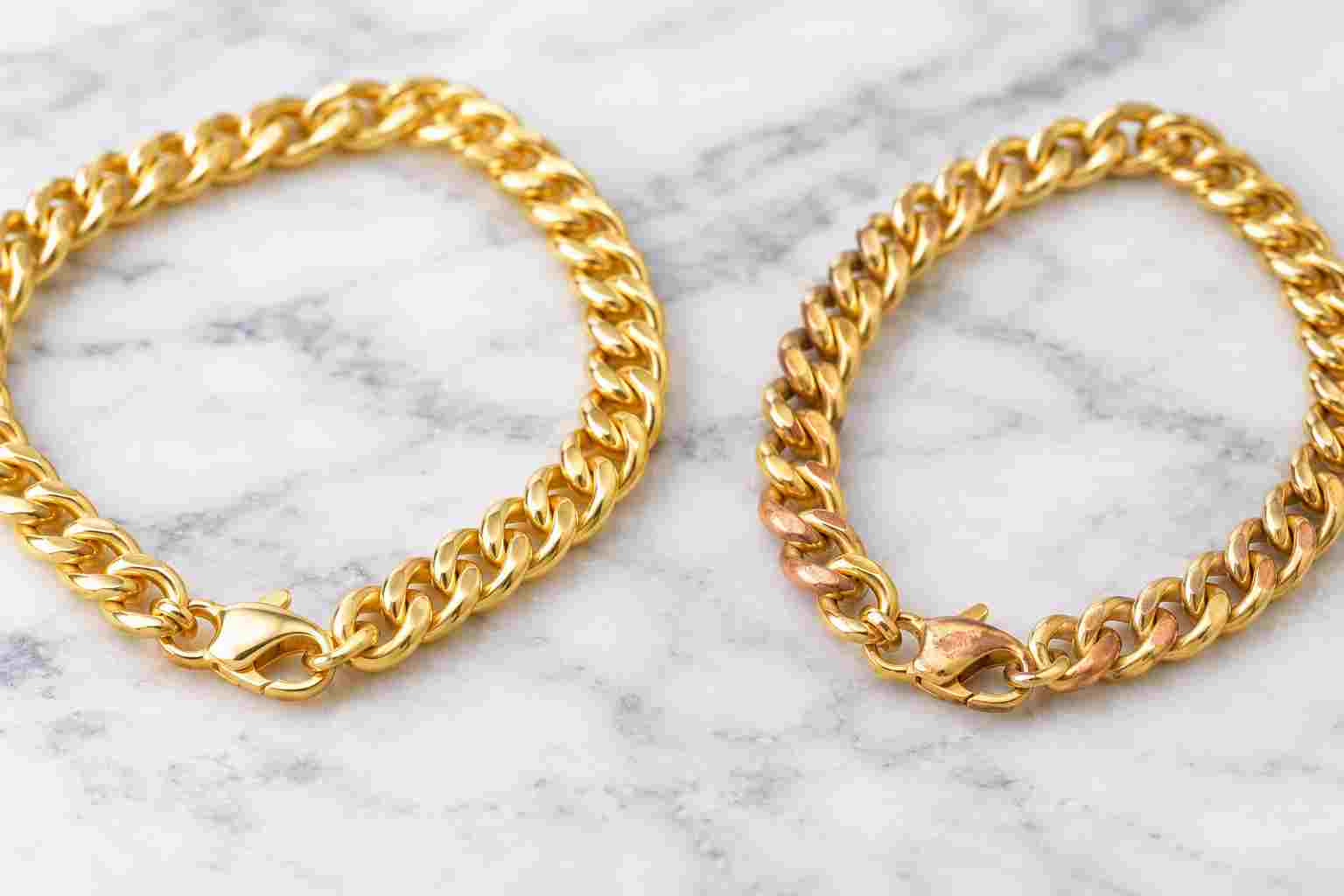
When plating wears through, the brass or copper underneath shows as a dull, coppery spot that can darken. When gold filled is well cared for, the gold layer usually stays intact for the life of the piece in normal wear. For pieces you’ll wear daily, such as a tennis bracelet or an everyday chain, that difference matters most.
Which Is Better for Sensitive Skin?
Gold filled is usually better for sensitive skin than gold plated, because its thick gold layer keeps the base metal away from your skin for much longer. With plated jewelry, the base metal can touch your skin once the thin gold wears, and if it contains nickel, that can trigger a rash.
The American Academy of Dermatology notes that nickel allergy is common and that jewelry and earrings are among the most frequent triggers. If you react to cheap jewelry, ask whether the base metal is nickel-free, and for earrings, check the post material. Our guide to post earring metals explains which posts are gentlest on skin.
How Can You Tell Gold Filled From Gold Plated?
The quickest way to tell gold filled from gold plated is the stamp: gold filled is marked “GF,” “1/20 14K GF” or “14/20,” while plated pieces may say “GP,” “GEP,” “HGE” or “18K GP,” or carry no mark at all. Check clasps, jump rings, ear wires and the inside of bands.
| Stamp | What it means |
|---|---|
| “1/20 14K GF” or “14/20” | Gold filled: 14K gold layer equal to 1/20 of the metal weight |
| “12/20” or “1/20 12K GF” | Gold filled with a 12K gold layer |
| “RGP” or “1/40 10K RGP” | Rolled gold plate: a bonded layer thinner than 1/20, with the fraction stated |
| “GEP” or “GP” | Gold electroplate, at least 0.175 microns under US guides |
| “HGE” or “HGP” | Heavy gold electroplate, at least about 2.5 microns |
| “18K GP” | Gold plated with 18K gold; it does not mean solid 18K |
| “14K” or “585” alone, with a maker’s mark | Usually solid 14K gold |
Marks can be faked or worn away, so a stamp isn’t proof on its own. A worn spot is a stronger clue: if you see a coppery or gray color on high points of a piece, the gold layer is thin, which points to plating. Our guide to spotting real gold walks through stamps, visual checks and jeweler testing.
Why Don’t Home Tests Work Well?
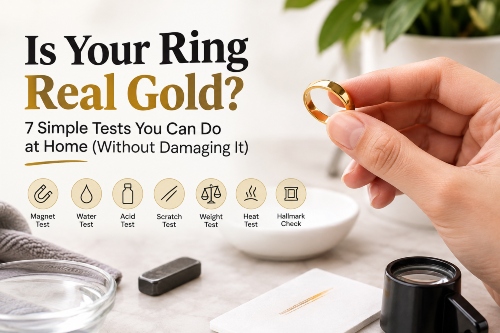
Home tests like the magnet test or a scratch test can’t reliably separate gold filled from gold plated, because both have a non-magnetic brass core and real gold on the surface. A scratch or acid test can also damage the piece.
Brass isn’t magnetic, so neither type sticks to a magnet. Surface acid tests read the gold layer, not the core, so both can pass. If you need certainty, a jeweler can test the piece without harming it, often with an X-ray fluorescence (XRF) analyzer [VERIFY].
How Do You Care for Gold Filled and Gold Plated Jewelry?
Clean both types with lukewarm water and a drop of mild dish soap, rinse, and dry with a soft cloth; gold filled can handle gentle buffing, but gold plated needs the softest touch because its layer is so thin. Simple habits make both last longer.
- Wipe after wearing. A soft, dry microfiber cloth removes sweat, skin oil and lotion before they build up.
- Wash when it looks dull. Soak for a few minutes in lukewarm water with a drop of mild dish soap, then brush very lightly with a soft baby toothbrush.
- Rinse and dry fully. Rinse in clean water, pat dry, and air-dry before storing so moisture doesn’t sit in clasps or links.
- Store pieces separately. Use soft pouches or a lined box so chains don’t tangle and scratch each other.
- Remove before water and chemicals. Take jewelry off before swimming, cleaning, applying lotion or using hairspray.
For chains, the gentle routine in our gold chain cleaning guide works for both types; just skip anything abrasive on plated pieces. For ear wires and studs, our guide on how to clean earrings explains how to clean posts safely.
Jeweler’s Tip: Gold filled jewelry can usually be buffed lightly with a soft jewelry cloth to bring back its shine, but use a plain microfiber cloth on gold plated pieces. Polishing cloths contain a mild abrasive, and on a thin plated layer, that can wear through to the brass.
Can You Shower in Gold Filled or Gold Plated Jewelry?
Gold filled jewelry usually handles occasional water better than gold plated, but it’s still best to take both off before showering, swimming or using a hot tub. Soap residue dulls the surface, and chlorine attacks gold alloys and the metals underneath.
Gold plated pieces are the most at risk. Water, sweat and soap speed up wear on the thin gold layer and can darken the brass once it’s exposed. Short contact, such as washing your hands, is generally fine if you dry the piece afterward.
Stop! Don’t do this. Don’t use toothpaste, baking soda pastes, bleach or silver dips on gold filled or gold plated jewelry, and don’t put plated pieces in an ultrasonic cleaner. These can scratch, strip or discolor the gold layer, and once plating is gone, it can only be restored by replating.
Gold Filled vs Gold Plated: Which Should You Buy?
Choose gold filled for jewelry you’ll wear often and want to last for years, and choose gold plated for low-cost trend pieces you’ll wear occasionally. For pieces you want to keep for life, solid gold is the only option that never wears through.
| Your situation | Best choice | Why |
|---|---|---|
| Everyday chain or necklace | Gold filled | Thick gold layer handles daily friction |
| Bracelets worn daily | Gold filled or solid gold | Wrists rub against desks and surfaces |
| Sensitive ears | Gold filled, or solid gold or titanium posts | Gold stays between skin and base metal longer |
| Trend pieces for a season | Gold plated | Lowest cost for short-term wear |
| Costume or event jewelry | Gold plated | Looks good for occasional use |
| Heirloom or engagement pieces | Solid gold | Keeps metal value and never wears through |
| Permanent welded jewelry | Gold filled or solid gold | Can’t be removed for care; see our guide to permanent jewelry |
Men’s jewelry follows the same logic. Chains and cuffs worn every day take a lot of friction, so gold filled is a practical step up from plated. Our guides on men’s bracelets and our men’s pendant guide cover styles that suit daily wear.
Are Gold Filled Rings a Good Idea?
Gold filled rings can last well, but rings take more wear than any other jewelry, and resizing can expose the core at the cut and solder point [VERIFY]. That’s why it’s worth getting the size right before you buy.
Our guide to measure ring size shows simple ways to find your size at home. If you’d like a silver-based alternative, keep in mind that sterling silver can darken over time; our guide to sterling silver tarnish explains why.
Gold Filled vs Gold Plated Myths vs Facts
| Myth | Fact |
|---|---|
| “Gold filled means gold on the inside.” | The gold is on the outside, bonded over a base metal core. |
| “Gold filled and gold plated are the same.” | Gold filled must have a gold layer equal to at least 1/20 of the metal weight; plating can be as thin as 0.175 microns. |
| “18K gold plated means solid 18K.” | It means a thin layer of 18K gold over another metal. |
| “Gold filled will never wear off.” | It lasts far longer than plating, but harsh chemicals and heavy friction can still wear it. |
| “A magnet test can tell them apart.” | Both usually have non-magnetic brass cores, so the magnet test doesn’t help. |
When Should You See a Jeweler?
See a jeweler if you need to know exactly what a piece is made of, if plating has worn through on a piece you love, or if a clasp, jump ring or link on gold filled jewelry is damaged. A jeweler can test the metal, replate worn plated jewelry, and repair gold filled pieces with the right materials.
It’s also worth a visit if a piece is causing a skin reaction. The jeweler can tell you whether the gold has worn through and whether replating, replacing the ear wires or switching to another metal makes sense.
Frequently Asked Questions About Gold Filled and Gold Plated Jewelry
What is gold filled jewelry?
Gold filled jewelry is a base metal core, usually brass, with a thick layer of karat gold bonded to it by heat and pressure. Under US guidelines, the gold must be at least 10K and make up at least 1/20 of the total metal weight. It looks like solid gold and lasts far longer than plating.
Is gold filled real gold?
The outer layer of gold filled jewelry is real karat gold, usually 12K or 14K, so you’re wearing real gold on the surface. The core is brass or another base metal, though, so gold filled is not solid gold. About 5% of its metal weight is karat gold, which affects its resale value.
Is gold filled better than gold plated?
For durability, yes. Gold filled has many times more gold than standard plating, so it resists wear, tarnish and color change much longer. It also keeps the base metal away from your skin longer. Gold plated is cheaper, which makes it a fair choice for trend pieces you won’t wear every day.
Does gold filled tarnish?
The gold layer itself resists tarnish, but gold filled jewelry can dull over time from skin oils, lotions and residue, and lower-karat gold can darken slightly. Regular wiping and an occasional wash with mild soap and water usually bring back the shine. Darkening on edges may mean the gold layer has worn.
How long does gold plated jewelry last?
Gold plated jewelry can last from a few weeks to a year or more, depending on the plating thickness, the type of piece and how often you wear it [VERIFY]. Rings and bracelets wear fastest. Heavy gold electroplate (HGE) lasts longer than standard plating, and gentle care helps every type last longer.
Can gold filled jewelry turn your skin green?
It’s uncommon while the gold layer is intact, because the brass core doesn’t touch your skin. If the gold wears through, usually after heavy use or harsh chemicals, the copper in brass can react with sweat and leave a green mark. Gold plated jewelry is much more likely to do this.
The Bottom Line on Gold Filled vs Gold Plated
When you compare gold filled vs gold plated, gold filled wins on durability and gold content, while gold plated wins on price. Gold filled jewelry carries a bonded layer of real 10K–14K gold equal to at least 1/20 of its weight, so it can last for years with simple care. Gold plated jewelry has a thin film of gold that suits occasional wear. Check the stamp, match the metal to how often you’ll wear the piece, and clean both gently with soap and water. If you’re also weighing a silver-based option, read our guide to gold vermeil next.

 By