
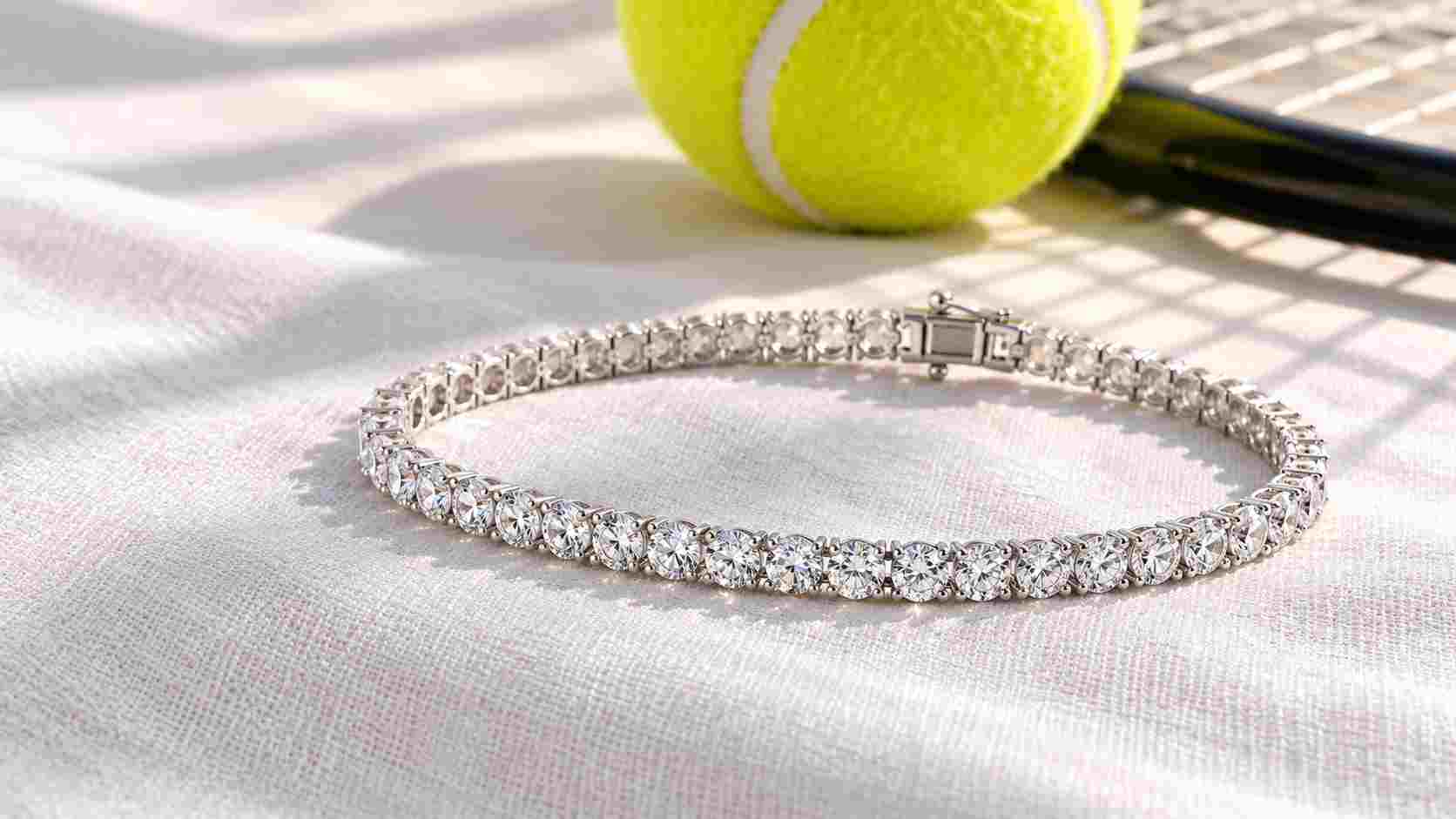
You’ve probably seen one on a wrist at a wedding, an office, or a red carpet: a slim, flexible line of sparkling stones that catches light with every move. Someone calls it a “tennis bracelet,” and you wonder what tennis has to do with diamonds.
What is a tennis bracelet? It is a flexible bracelet made of a single, continuous line of matching gemstones, traditionally diamonds, each set in its own small mount and linked so the bracelet bends like a chain. It usually closes with a box clasp and a safety latch. The name comes from tennis champion Chris Evert, who famously lost one during a match.
Key Takeaways
- A tennis bracelet is one continuous row of matching stones, set individually and linked to flex.
- The name traces to Chris Evert, though sources disagree on the year of her famous lost bracelet.
- Diamond weight is shown as total carat weight (ctw) for all stones combined.
- Stones can be natural diamonds, laboratory-grown diamonds, moissanite, cubic zirconia or colored gems.
- A box clasp plus a safety latch is the standard way to keep it on your wrist.
- It should fit with about a finger’s width of space, loose enough to move but not slide off.
What Is a Tennis Bracelet?
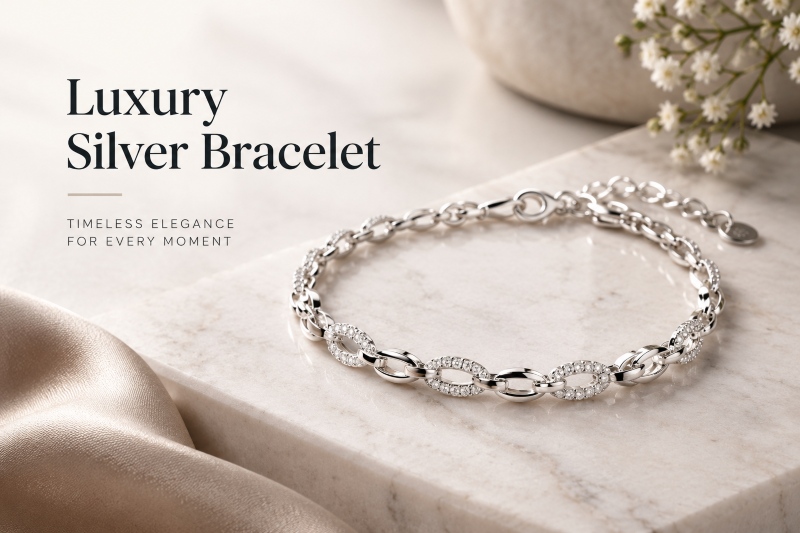
A tennis bracelet is a bracelet made entirely of a single line of gemstones of uniform size and cut, each held in its own setting and connected by small hinges so the piece drapes smoothly around the wrist. There is no chain between the stones. The stones themselves, in their settings, form the bracelet.
GIA’s jewelry experts describe the style as a line bracelet traditionally set with diamonds that can also feature colored stones or a mix of both. What separates it from other bracelets is the unbroken, symmetrical line. A charm bracelet or a chain bracelet with a few stations is not a tennis bracelet. If you are comparing styles, our guide to men’s bracelet styles explains chains, cuffs and bangles.
What Is the Tennis Bracelet Meaning?
The tennis bracelet meaning is practical: the term describes a flexible line of matching stones, named after a famous moment in tennis rather than a symbol or tradition. Before the tennis name, the same design was commonly sold as a “line bracelet” or “eternity bracelet,” a name borrowed from eternity rings, which also carry an unbroken line of stones.
Today, tennis bracelets are popular gifts for milestones such as anniversaries, graduations and promotions, partly because the continuous line suggests something lasting. That symbolism is a tradition people attach to the piece, not part of its definition. With the meaning settled, here is the story behind the name.
Why Is It Called a Tennis Bracelet?
It is called a tennis bracelet because Chris Evert stopped a U.S. Open match to search for her diamond line bracelet after its clasp broke, and she later called it her “tennis bracelet” when asked about it. According to GIA, she asked for a pause during a close match, the bracelet’s clasp had broken, and the publicity made the name stick. GIA also notes the bracelet was made by jewelry designer George Bedewi.
The year is where accounts differ. GIA’s article dates the incident to the 1987 U.S. Open. Evert’s own jewelry collaboration, however, dates it to 1978, and newspaper coverage from before the 1987 tournament was already using the phrase “tennis bracelet.” What all sources agree on is the essentials: Evert, a U.S. Open match, a lost diamond line bracelet, and a name that spread quickly through jewelry stores afterward.
Jeweler’s Tip: The lesson from Evert’s story is the clasp, not the court. Always choose a tennis bracelet with a secondary safety latch, as GIA recommends, because a box clasp alone can open under strain.
What Are the Parts of a Tennis Bracelet?
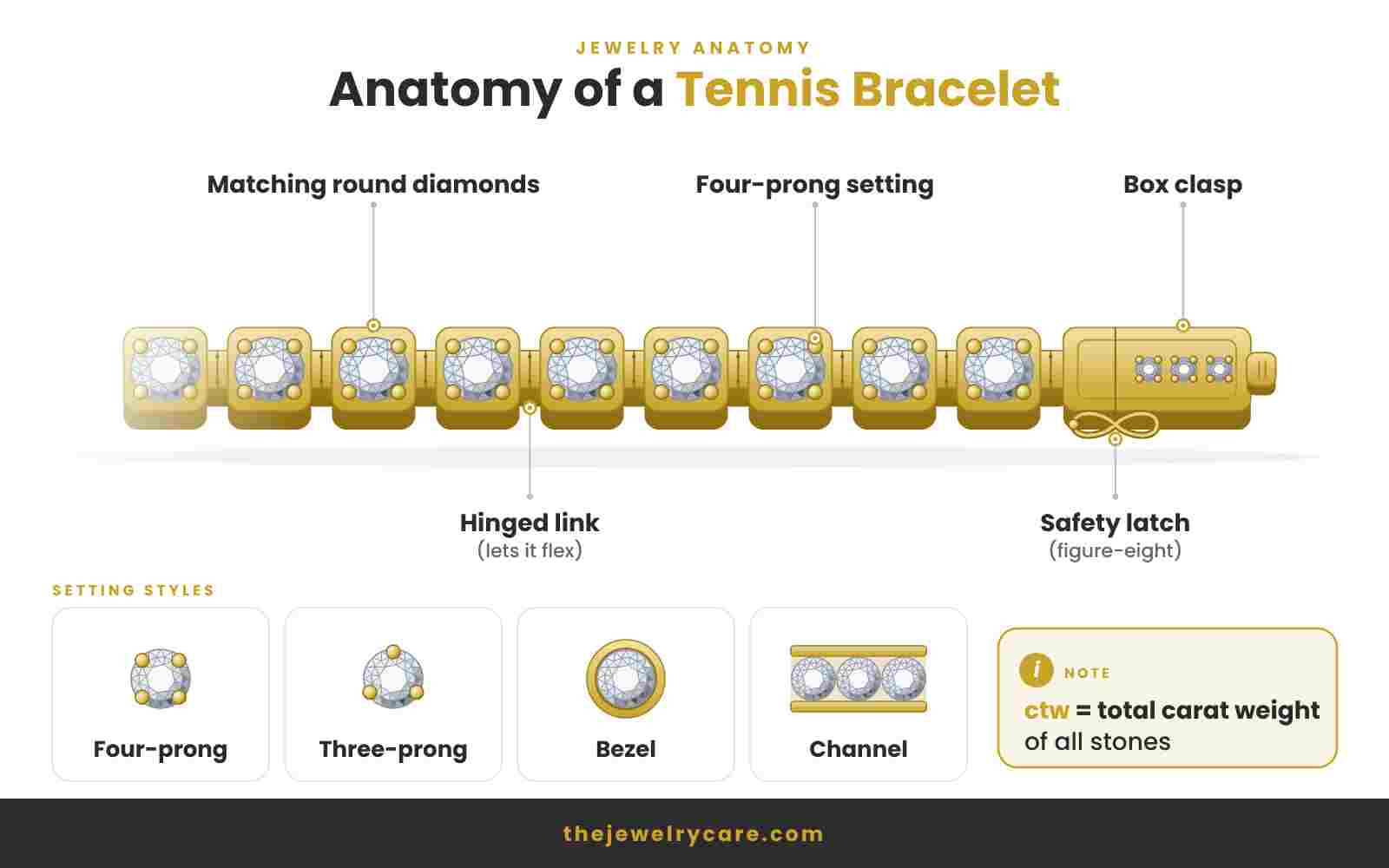
A tennis bracelet has four main parts: the stones, the individual settings that hold them, the hinged links between settings, and the clasp with a safety catch. The infographic below shows each part.
Which Tennis Bracelet Setting Is Best?
Four-prong settings show the most diamond and sparkle, bezel settings protect stones best, and channel settings give the smoothest, most snag-free surface. The setting affects sparkle, security and how often the bracelet catches on clothing.
| Setting | How it holds the stone | Sparkle | Security and comfort |
|---|---|---|---|
| Four-prong | Four small claws grip each stone | Highest; most light reaches the stone | Prongs can catch on knits and need regular checks |
| Three-prong (“buttercup” or martini) | Three claws in a V-shaped cup | High; stones sit close together | Fewer prongs to check, but each carries more load |
| Bezel | A thin metal rim surrounds each stone | Slightly lower | Very secure; smooth edges rarely snag |
| Channel | Stones sit in a groove between two metal walls | Moderate | Smooth and sturdy; good for daily wear |
| Illusion | A shaped metal plate around small stones makes them look larger | Looks bigger than the actual stones | Usually used with smaller stones to reduce cost |
The same prong-versus-bezel trade-offs apply to rings and earrings. Our guide to cleaning a diamond ring explains how to check prongs for wear, and the same check works for a bracelet.
What Stones Are Used in Tennis Bracelets?
Tennis bracelets are made with natural diamonds, laboratory-grown diamonds, moissanite, cubic zirconia or colored gemstones such as sapphire, ruby, emerald and topaz. The stone choice sets most of the price and changes how the bracelet should be described when sold.
| Stone | What it is | Hardness (Mohs) | What to know |
|---|---|---|---|
| Natural diamond | Mined carbon crystal | 10 | The classic choice; graded by the 4Cs |
| Laboratory-grown diamond | Carbon crystal grown in a lab, same properties as mined diamond | 10 | Must be disclosed as laboratory-grown or similar |
| Moissanite | Silicon carbide, a different mineral | 9.25 | Very bright, with more colorful fire than diamond |
| Cubic zirconia (CZ) | A man-made simulant | About 8–8.5 | Lowest cost; can scratch and cloud over time |
| Sapphire, ruby | Corundum gems | 9 | Durable; popular in alternating designs with diamonds |
| Emerald | A beryl gem | 7.5–8 | Often treated and more fragile; needs gentle care |
US rules require clear wording. The FTC advises that laboratory-created diamonds be described with terms such as “laboratory-grown” or “laboratory-created” placed immediately before the word “diamond,” and that simulants be labeled “imitation” or “simulated.” If a listing just says “diamond tennis bracelet” at a very low price, ask exactly which stone it is. Colored birthstone tennis bracelets are popular too; our November birthstone guide explains topaz and citrine care.
What Does “ctw” Mean on a Tennis Bracelet?
“ctw” means carat total weight: the combined weight of all the stones in the bracelet, not the size of any single stone. A carat is 200 milligrams, so a “3 ctw” bracelet holds 0.6 grams of diamonds in total, spread across all its stones.
The FTC’s Jewelry Guides say diamond weight must not be misrepresented, and that fractional weights need a disclosure that the weight is not exact, with a reasonable range. Two bracelets with the same ctw can look very different: one may use many tiny stones, another fewer, larger ones. Ask for the number of stones and the approximate size of each.
Which Metal Is Best for a Tennis Bracelet?
14K white gold, 18K gold and platinum are the most common metals for diamond tennis bracelets, while sterling silver is used for lower-cost and simulant versions. The metal affects durability, color and price.
| Metal | Look | Durability | Notes |
|---|---|---|---|
| 14K white, yellow or rose gold | Classic and bright | Very good; harder than 18K | The most common choice for diamond tennis bracelets |
| 18K gold | Richer color | Good; softer, so prongs wear faster | Higher gold content and value |
| Platinum | Cool white | Excellent; dense and secure | Highest cost; heaviest |
| Sterling silver | Bright white | Fair; softer and tarnishes | Common for CZ and moissanite versions |
If you have sensitive skin, the American Academy of Dermatology recommends nickel-free or hypoallergenic metals such as platinum, high-karat gold and sterling silver. Sterling versions will darken over time, as our guide to sterling silver tarnish explains. For gold bracelets, our guide to 14K bracelet value shows how metal weight and karat add up, and our guide to spotting real gold explains the stamps to check on the clasp.
How Should a Tennis Bracelet Fit?
A tennis bracelet should fit with about a finger’s width of space between the bracelet and your wrist: loose enough to move, but not so loose it can slide over your hand. To find your length, measure your wrist with a soft tape just above the wrist bone, then add about 1/2 to 1 inch (1.3 to 2.5 cm).
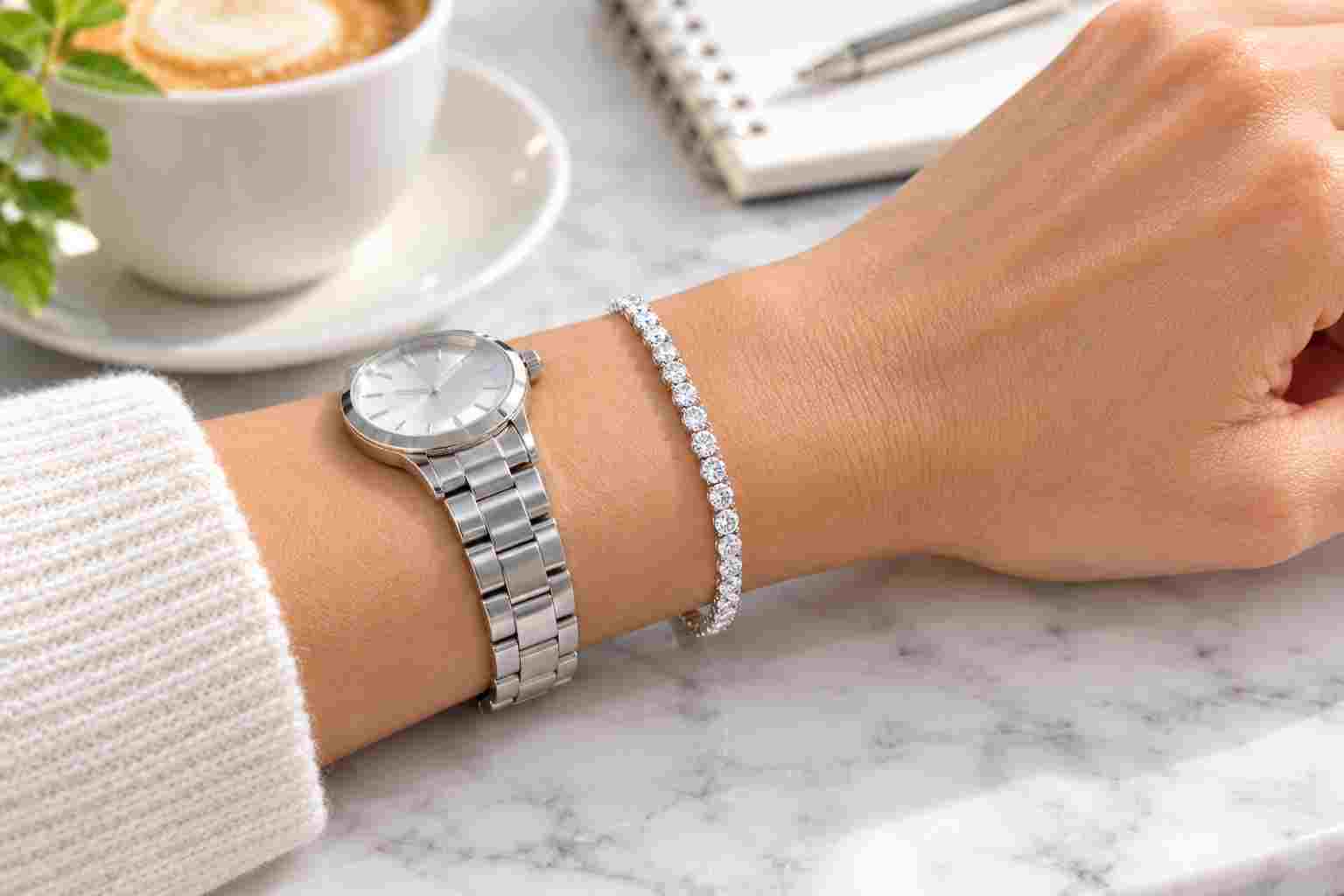
Many tennis bracelets are sold in a standard women’s length of about 7 inches [VERIFY], with men’s versions often longer. A bracelet that is too loose rolls down over the hand and puts strain on the clasp; one that is too tight presses the settings into the skin. Bracelet sizing works differently from rigid bangles, which must pass over the whole hand, as our guide on how to measure bangle size explains, and from rings, covered in our guide on how to measure ring size.
How Do You Keep a Tennis Bracelet Secure?
Keep a tennis bracelet secure by choosing a box clasp with a safety latch, having a jeweler check the clasp and settings regularly, and taking it off for sports, gym sessions and heavy work. GIA’s experts recommend a safety catch on the side of the bracelet in addition to the main clasp, plus regular checks of the clasp, catch and mountings.
Check your bracelet yourself every few weeks. Hold it near your ear and shake it gently: a rattle can mean a loose stone. Look for prongs that are bent, flattened or catching on fabric. Test that the clasp clicks firmly and the safety latch closes fully. If anything feels loose, stop wearing it until a jeweler has repaired it.
Stop! Don’t do this. Don’t wear a tennis bracelet for tennis, golf, the gym or lifting, despite the name. Impact and strain can bend prongs, loosen stones and pop a clasp open. And never pull a tennis bracelet off over your hand without opening the clasp.
How Do You Clean a Tennis Bracelet?
Soak a diamond tennis bracelet for a few minutes in warm water with a few drops of mild dish soap, brush gently around each setting with a soft toothbrush, rinse over a closed drain, and dry it fully. GIA also recommends cleaning the diamonds periodically to keep them sparkling, because skin oil and lotion dull diamonds quickly.
For detailed steps, our guides to diamond earring care and cleaning a diamond ring use the same method. Sterling silver tennis bracelets need silver care; see our guide to clean silver jewelry. Avoid soaking bracelets with emeralds, opals or other treated stones, and skip ultrasonic cleaners if any stone is fracture-filled or the settings are worn.
Can Men Wear Tennis Bracelets?
Yes. Men wear tennis bracelets, usually in longer lengths with larger stones, heavier links or darker metals, and often paired with a watch or chain. Men’s versions are also sold as “tennis chains” when made as necklaces. Our guide to men’s bracelet styles covers sizing for men’s wrists and how to stack a bracelet with a watch.
Tennis Bracelet Myths vs Facts
| Myth | Fact |
|---|---|
| “Tennis bracelets were designed for playing tennis.” | The style existed first as the line or eternity bracelet; the name came later from Chris Evert. |
| “Every tennis bracelet has real diamonds.” | Many use lab-grown diamonds, moissanite or cubic zirconia; sellers should say which. |
| “Higher ctw always means bigger stones.” | ctw is the total for all stones; a bracelet can have high ctw from many tiny stones. |
| “A box clasp alone is enough.” | GIA recommends a safety catch in addition to the main clasp. |
| “Tennis bracelets can’t be worn every day.” | Many people wear them daily; secure settings and regular checks make that practical. |
Frequently Asked Questions About Tennis Bracelets
What is the difference between a tennis bracelet and a regular bracelet?
A tennis bracelet is made entirely of one continuous line of matching stones, each in its own setting and linked to flex. A regular bracelet is usually a chain, cuff or bangle, sometimes with a few stones or charms. In a tennis bracelet, the stones are the structure, not decoration added to a chain.
What was the tennis bracelet called before?
Before the tennis name became popular, the same design was commonly called a “line bracelet” or “eternity bracelet.” The new name spread after Chris Evert’s famous lost bracelet at the U.S. Open, and jewelers soon began using “tennis bracelet” for any flexible line of matching stones.
How many carats is a good tennis bracelet?
There is no single right number; it depends on the look and budget you want. Lighter bracelets of about 1 to 2 ctw look delicate and suit daily wear, while 3 ctw and above look bolder [VERIFY]. Compare stone count, stone size, cut quality and settings, not just ctw.
Is a lab-grown diamond tennis bracelet real?
Yes. Laboratory-grown diamonds have essentially the same optical, physical and chemical properties as mined diamonds, so they are real diamonds that were made in a lab. US rules require sellers to disclose that they are laboratory-grown. They usually cost less than comparable natural diamonds.
Can you wear a tennis bracelet in the shower?
It is better not to. Soap film dulls diamonds, hot water and chlorine can harm some metals and treated stones, and wet skin makes a bracelet more likely to slip off when the clasp is opened. Remove it before showering, swimming and using lotion, then put it back on once dry.
Is a tennis bracelet a good gift?
Yes. Its simple, symmetrical design suits most styles, and it works for anniversaries, graduations and milestone birthdays. For a meaningful pairing, some people give one alongside a promise ring; our guide to promise vs engagement rings explains the difference between the two.
Can a tennis bracelet be made permanent?
Traditional tennis bracelets use clasps so they can be removed. Permanent jewelry studios weld fine chains closed instead, and some now offer welded chains with small stones. Our guide to permanent jewelry explains how welded pieces are fitted and removed.
A Simple Line With a Famous Story
So, what is a tennis bracelet? It is a single, flexible line of matching stones, once called a line or eternity bracelet, that took its name from Chris Evert’s famous lost bracelet. When you buy one, check the stone type and its disclosure, the ctw and stone count, the setting, the metal and, above all, the clasp and safety latch. Then keep it clean and checked, and it will stay secure and sparkling for years. For matching studs, our guide to post earring styles is a good next read.

 By