
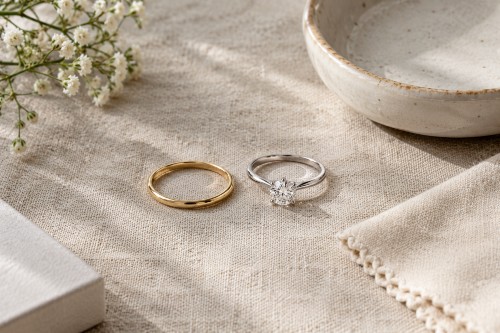
A promise ring shows commitment to a relationship without a set plan to marry. An engagement ring shows that two people have agreed to get married. Promise rings are usually simpler, cost less and can go on any finger. Engagement rings usually have a prominent centre stone, cost more and are worn on the left ring finger in most Western countries.
In short, a promise ring says “I’m committed to you”, and an engagement ring says “we’re getting married.” The rest of this guide explains every difference, so you can choose the right ring and avoid a very awkward misunderstanding.
Promise ring vs engagement ring at a glance
| Attribute | Promise ring | Engagement ring |
|---|---|---|
| Meaning | Commitment, exclusivity or a personal vow | An agreed plan to marry |
| What comes next | Nothing fixed | Wedding planning |
| When it’s given | Any time: anniversary, birthday, long distance | At or after a proposal |
| Typical design | Slim band, small stone, birthstone or engraving | Prominent centre stone, often a diamond |
| Common metals | Sterling silver, 10K–14K gold | 14K–18K gold, platinum |
| Typical cost (US) | About $50–$500 | Often $1,000 to many thousands |
| Usual finger | Any; often the right ring finger | Left ring finger (in most Western countries) |
| Who’s involved | Usually just the couple | Often family and friends |
| Legal status if you split | Usually treated as an ordinary gift | Often treated as a conditional gift (varies by state) |
Prices vary widely by metal, stone and brand, so treat them as rough guides.
What is a promise ring?
A promise ring is a ring given to show a commitment that isn’t a proposal. Its meaning is set by the two people involved, which makes it flexible but also easy to misunderstand.
A promise ring can mean:
- “We’re exclusive.” A sign that the relationship is serious.
- “I’ll wait for you.” Common in long-distance relationships or during study or military service.
- “I see a future with you.” Sometimes called a pre-engagement ring.
- A personal vow. For example, a purity ring or a sobriety ring.
- Friendship. Some close friends exchange matching promise rings.
Because there are no fixed rules, a promise ring only works when both people know what it means. Say it out loud when you give it.
What is an engagement ring?
An engagement ring is a ring given with a marriage proposal, or chosen together after one. It tells the world that two people plan to marry, and it’s usually worn every day until the wedding, then alongside a wedding band.
Unlike a promise ring, an engagement ring comes with shared expectations. Family and friends usually hear the news, wedding planning begins, and in many cultures there are engagement ceremonies or ring exchanges. Its meaning is fixed, which is exactly why a promise ring that looks like an engagement ring causes confusion.
Where do promise rings and engagement rings come from?
Rings have been used to mark commitment for about 2,000 years, and the two traditions developed separately.
Engagement rings go back to ancient Rome, where a ring was often given at betrothal. Many Roman examples show two clasped right hands, a symbol of agreement. The Victoria and Albert Museum holds a Roman ring of this type, and the British Museum holds a 3rd-century Roman gold ring with portraits of a man and a woman.
Promise rings have a closer ancestor in the English posy ring. These were simple gold bands engraved with a short motto, often inside the band where only the wearer could read it. They were given as tokens of love, friendship or betrothal. The Metropolitan Museum of Art holds one from around 1600 inscribed “I Like My Choyse”, and the British Museum holds several more.
The idea that an engagement ring must be a large diamond, or cost a set number of months’ salary, is much newer. It grew out of 20th-century diamond advertising, not long tradition.
What are the 9 key differences?
- Meaning. A promise ring means commitment; an engagement ring means an agreed plan to marry.
- Timing. A promise ring can be given any time; an engagement ring comes with a proposal.
- What comes next. Nothing fixed after a promise ring; wedding planning after an engagement ring.
- Design. Promise rings are usually slim and simple; engagement rings usually feature a centre stone.
- Stone. Promise rings often use birthstones, small diamonds or no stone; engagement rings usually use a diamond, lab-grown diamond, moissanite or sapphire.
- Finger. Promise rings can go on any finger; engagement rings usually go on the left ring finger.
- Cost. Promise rings usually cost far less.
- Audience. Promise rings are often private; engagement rings are announced to family and friends.
- Legal status. In many US states, an engagement ring is a conditional gift; a promise ring is usually an ordinary gift.
How do you choose between a promise ring and an engagement ring?
Work through these steps in order. Most couples know the answer by step 3.
- Ask whether marriage is the agreed plan. If you’ve both said you want to marry soon, you’re choosing an engagement ring. If you’re serious but not there yet, choose a promise ring.
- Talk before you buy. One honest sentence prevents most mix-ups: “I want to give you something that shows I’m serious, but this isn’t a proposal.”
- Decide what the ring should say. Choose the meaning first, then a design that matches it.
- Set a budget you can afford. Don’t borrow for either ring. A small, solid ring means more than an expensive one that causes stress.
- Match the ring to daily life. Tall diamond settings catch on gloves and knitwear; slim bands bend under heavy gripping. Think about your work, sport and hobbies.
- Check the size. Borrow a ring they already wear, or choose a jeweller with free resizing.
- Pick the finger. Use a different finger for a promise ring if you don’t want people to assume you’re engaged. Our guide on what finger a promise ring is worn on covers every option.
How should a promise ring look different from an engagement ring?
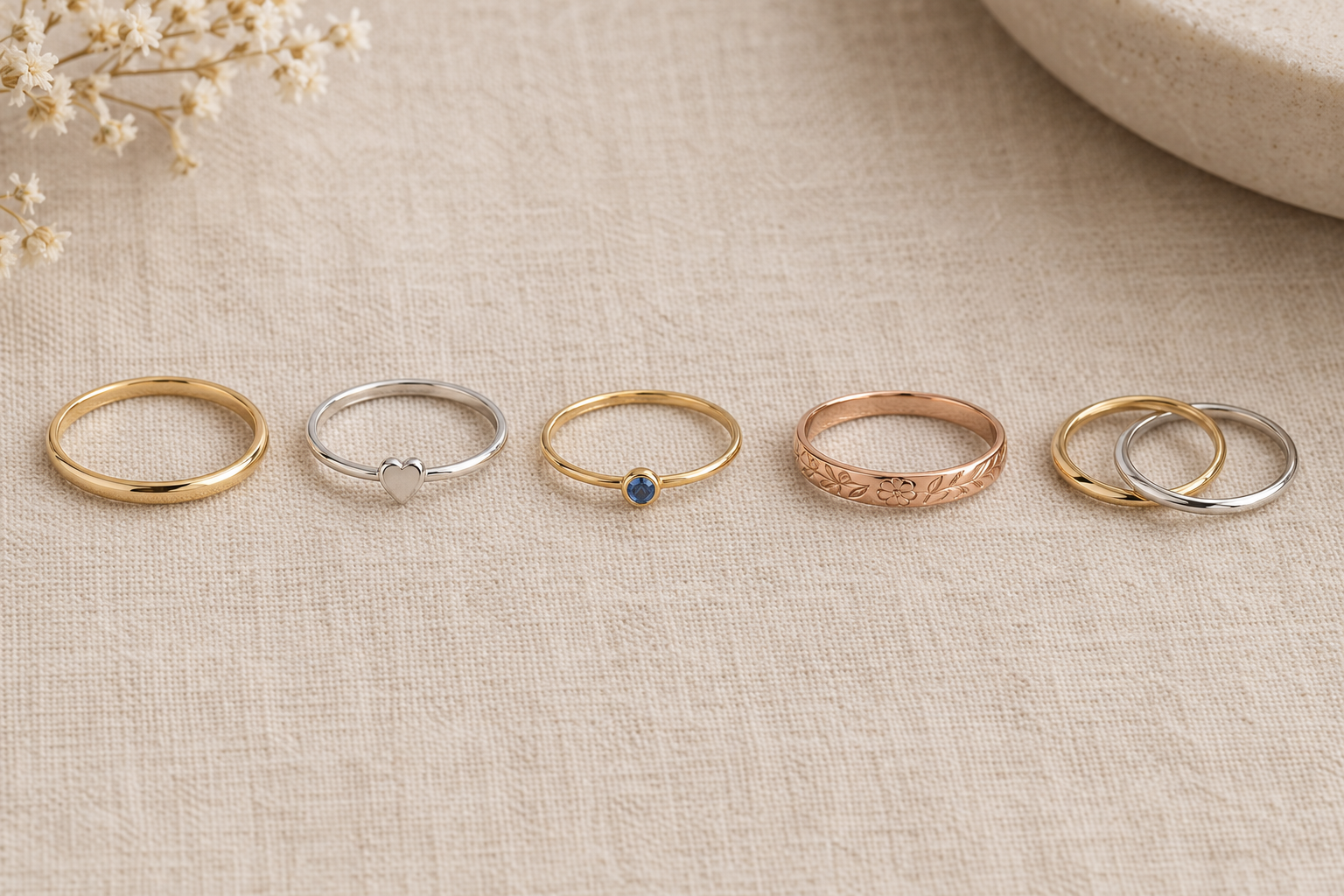
The safest way to avoid confusion is to make the design itself say “promise”, not “proposal”. Choose one of these styles:
- Plain or engraved band. A simple gold or silver band with initials, a date or a short message, just like a posy ring.
- Birthstone ring. A small coloured stone instead of a clear one.
- Heart, infinity or knot design. Clearly romantic, clearly not a solitaire.
- Small cluster or bezel-set stone. A low-profile stone that doesn’t sit high like a solitaire.
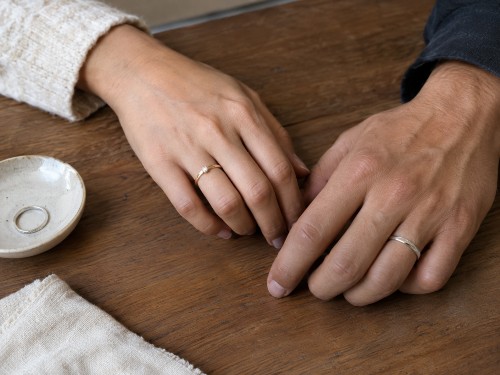
- Matching pair. Two simple bands, one for each partner.
Avoid a single clear stone on a tall four- or six-prong setting if you’re not proposing. That look reads as “engagement” to almost everyone.
How much should you spend on each ring?
There’s no correct amount for either ring. Spend what you can afford without debt.
Promise ring budget: Most cost $50–$500. Sterling silver and 10K gold keep the price low; solid 14K gold and small diamonds push it higher.
Engagement ring budget: These often cost from about $1,000 up to many thousands of dollars. The centre stone drives most of the price. For diamonds, price depends on the 4Cs: colour, clarity, cut and carat weight. The Gemological Institute of America explains that a carat is 200 milligrams and that two diamonds of the same weight can have very different prices because of the other three Cs.
Ways to make either budget go further:
- Choose a lab-grown diamond or moissanite instead of a mined diamond.
- Choose a slightly smaller stone with an excellent cut; cut affects sparkle most.
- Choose 14K gold instead of 18K or platinum.
- Choose a simple setting and upgrade later.
To understand what the metal itself is worth, see how much a 14K gold ring is worth.
What should you know about diamonds and lab-grown stones?
Lab-grown diamonds have the same chemical, physical and optical properties as mined diamonds, but they usually cost much less. That makes them popular for both promise and engagement rings.
The key is honest labelling. The FTC’s Jewelry Guides, §23.12, define the word “diamond”. The FTC has also warned sellers that calling a lab-created stone simply a “diamond” can mislead buyers into thinking it was mined, so the disclosure must be clear and close to the product.
When you buy any diamond:
- Ask whether it’s mined, lab-grown or a simulant (such as cubic zirconia).
- Ask for a grading report from an independent lab for larger stones.
- Make sure the receipt states the stone type in writing.
Which metals are best for each ring?
The right metal depends on how often the ring will be worn and your budget.
| Metal | Best for | Notes |
|---|---|---|
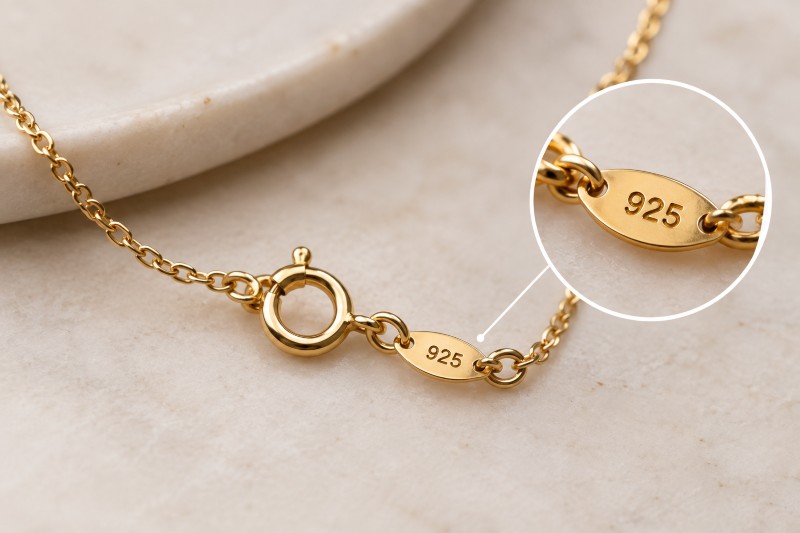
| Sterling silver (925) | Budget promise rings | Tarnishes; bends more easily than gold |
| 10K gold | Durable, affordable promise rings | 41.7% gold; paler colour |
| 14K gold | Everyday promise and engagement rings | 58.3% gold; a strong balance of colour and durability |
| 18K gold | Engagement rings | 75% gold; richer colour but softer |
| Platinum | Engagement rings; sensitive skin | Dense, strong and naturally white |
The GIA’s guide to gold karats notes that lower-karat gold is generally more durable, while higher karats are softer. Always check the stamp inside the band (14K, 585, 18K, 750, PT950) and confirm a ring is solid, not plated, with our guide on how to tell if a ring is real gold.
If your partner has sensitive skin, avoid nickel. The American Academy of Dermatology lists nickel among the most common causes of skin reactions to jewellery and recommends nickel-free metals such as platinum and higher-karat gold.
How do you give a promise ring without it looking like a proposal?
The ring can’t explain itself, so the moment has to. Follow these steps:
- Choose a calm, private setting, like a quiet dinner or a walk, not a crowded restaurant.
- Don’t kneel. Kneeling signals a proposal everywhere.
- Say what it means first, before you open the box: “This isn’t a proposal. It’s a promise that I’m committed to you.”
- Put it on a finger other than the left ring finger, unless you’ve agreed otherwise.
- Leave space to talk about what you both hope for next.
What are the most common mix-ups, and how do you fix them?
Even careful couples hit these situations. Here’s how to handle each one.
“My partner thought it was a proposal.” Stay calm and be clear: “I’m sorry for the confusion. This is a promise ring. I’m serious about us, but this isn’t a proposal yet.” Then talk about timelines.
“People keep congratulating me on my engagement.” Move the ring to your right hand, or choose a less solitaire-like design next time.
“It’s been years, and there’s no engagement.” A promise ring shouldn’t become a waiting game. Have a direct conversation about what each of you expects, even if the answer is a rough timeline.
“The ring turned my finger green.” This usually comes from copper in cheap alloys or worn plating reacting with sweat and lotion. Take the ring off before applying hand cream, and choose solid gold or platinum next time.
“The thin band bent.” Very slim bands bend under heavy gripping. Take the ring off for the gym and heavy chores, and have a jeweller reshape it early.
Who keeps the ring if you break up?
It depends on the ring and where you live. This isn’t legal advice, but the general US picture is clear.
Engagement rings: Most US states treat an engagement ring as a conditional gift. It’s given on the condition that the marriage happens. If the engagement ends, the ring usually goes back to the person who gave it. In 2024, Massachusetts’s highest court joined this approach and held that the ring should be returned regardless of who ended the engagement, as explained by Harvard Law School professor Joseph Singer. A minority of states still apply fault or treat the ring as an ordinary gift.
Promise rings: These are usually treated as ordinary gifts, so the person who received it normally keeps it.
If a valuable ring is involved, check your local law or speak to a lawyer.
What happens to a promise ring after you get engaged?
Most people keep wearing it in one of these ways:
- Move it to the right hand.
- Stack it with the engagement ring, if the shapes sit well together.
- Wear it on a chain as a necklace.
- Turn it into a wedding band, if both of you agree and it fits the engagement ring.
- Keep it as a keepsake in a ring box.
Some couples skip rings altogether and choose matching welded bracelets instead; see our guide to permanent jewelry.
Promise ring vs engagement ring vs wedding band
| Promise ring | Engagement ring | Wedding band | |
|---|---|---|---|
| Given when | Any time | At the proposal | At the wedding ceremony |
| Means | Commitment | Agreement to marry | Marriage |
| Typical look | Slim, simple | Centre stone | Plain or lightly set band |
| Worn by | Either partner | Usually one partner | Usually both partners |
Planning ahead? See how much a 14K gold wedding ring is worth to budget for bands.
How do you care for each ring?
Both rings need gentle, regular cleaning, but engagement rings need more inspection because of their stones and prongs.
Engagement ring care:
- Have a jeweller check the prongs every 6–12 months. A loose prong is the most common way stones are lost.
- Take it off for the gym, gardening, cleaning and swimming.
- Store it alone in a lined box so the diamond doesn’t scratch other jewellery.
Promise ring care:
- Watch thin bands for bending and thin spots.
- Wipe silver rings with a polishing cloth to remove tarnish.
- Remove it before applying lotion to stop build-up.
Simple home clean for both:
- Soak the ring in warm water with a few drops of mild dish soap for 10–15 minutes.
- Brush gently with a soft toothbrush, especially under the stone.
- Rinse under clean water (close the sink drain first).
- Pat dry with a lint-free cloth.
For stone-safe detail, follow our guide on how to clean a diamond ring.
Can men wear promise rings and engagement rings?
Yes. Men’s promise rings are usually plain bands in gold, silver, tungsten or titanium, sometimes engraved. Men’s engagement rings are also becoming common, often a slightly wider band with a small flush-set stone. If he prefers something other than a ring, a bracelet or pendant works too; see do men wear bracelets.
Frequently asked questions
Is a promise ring the same as an engagement ring? No. A promise ring shows commitment; an engagement ring shows an agreed plan to marry.
Can you propose with a promise ring? You can, but it often causes confusion. If you do, say clearly that it’s a proposal, or that you’ll choose an engagement ring together.
Can a promise ring become an engagement ring? Yes, if you both agree. Some couples buy a promise ring knowing it’ll become the engagement ring later.
Which hand does a promise ring go on? Either. Many people wear it on the right ring finger so it isn’t mistaken for an engagement ring.
How long after a promise ring do people get engaged? There’s no standard timeline. Some couples get engaged within months, some after years, and some never.
Do both partners wear promise rings? Often, yes. Matching promise rings are common.
Is a promise ring childish? No. Adults of all ages give promise rings to mark commitment, anniversaries or long-distance relationships.
What’s the difference between a promise ring and a purity ring? A promise ring is a commitment to another person. A purity ring is a personal vow, usually religious.

 By