
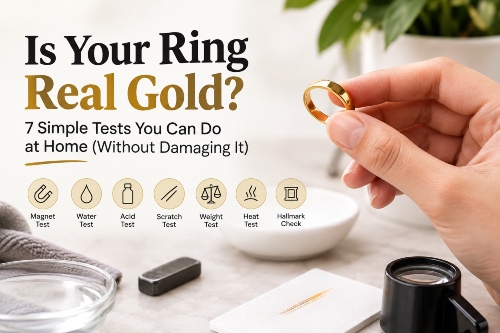
Finding a vintage gold ring at a thrift store, receiving a family heirloom, or simply double-checking a prized piece of jewelry always comes with one big question: Is this ring actually real gold, or just a clever imitation?
Real gold is rare, heavy, and tarnish-resistant. However, fake gold and gold-plated imitations can easily trick the naked eye.
Before you try aggressive home remedies that could permanently damage your ring, use this step-by-step guide to test your gold ring safely at home—plus learn when it’s time to call in a professional jeweler.
| Test Method | Real Gold Behavior | Fake / Plated Gold Behavior | Risk Level to Ring |
| Hallmark Check | Stamped with 10K, 14K, 18K, or 585, 750 | Stamped with GP, GF, GEP, or no stamps | 🟢 Zero Risk |
| Magnet Test | Absolutely zero magnetic attraction | Sticks or pulls toward the magnet | 🟢 Zero Risk |
| Skin Test | Leaves skin clean and unaffected | Turns skin green, black, or dark blue | 🟢 Zero Risk |
| Float/Water Test | Sinks quickly to the very bottom | Floats, drifts, or sinks slowly | 🟢 Zero Risk |
| Ceramic Scratch | Leaves a bright yellow gold trail | Leaves a dark black or grey streak | 🟡 Mild Scratch Risk |
| Vinegar Drop | No color change or reaction | Darkens, changes color, or fizzes | 🟡 Tarnish Risk |
Phase 1: Zero-Risk Visual & Non-Destructive Checks
Always start with non-destructive tests. These take seconds and carry zero risk of scratching or dulling your ring.
1. The Hallmark & Stamp Inspection (Magnifying Glass Test)
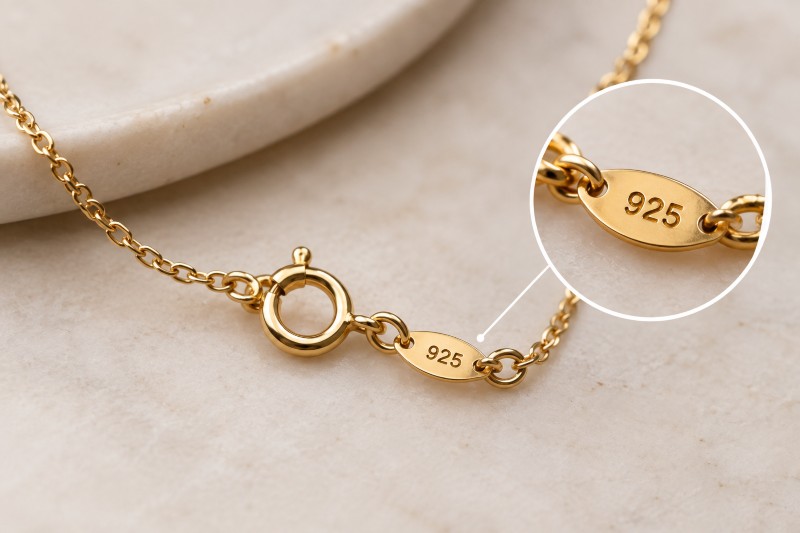
Real gold jewelry almost always features a hallmark—a small purity mark stamped on the inside band of the ring.
💡 How to do it: Grab a magnifying glass or zoom in using your smartphone camera and look closely at the inner band.
- Valid Gold Karat Stamps:
10K,12K,14K,18K,22K, or24K. - Valid Millesimal Fineness Stamps:
- 417 = 10K (41.7% pure gold)
- 585 = 14K (58.5% pure gold)
- 750 = 18K (75.0% pure gold)
- 916 = 22K (91.6% pure gold)
⚠️ Watch Out for Gold-Plated Acronyms
If you see any of these letter markings next to the stamp, your ring is not solid gold—it is base metal covered with a thin layer of gold plating:
- GP (Gold Plated)
- GF (Gold Filled)
- GEP / GE (Gold Electroplated)
- HGP (Heavy Gold Plated)
2. The Skin Contact Test
Pure gold is an inert metal. It does not oxidize or react with body oils, sweat, or moisture.
💡 How to do it: Hold the ring tightly between your palms for 2 to 3 minutes until your sweat interacts with the metal.
- Real Gold Result: Your skin remains completely normal.
- Fake Gold Result: Your skin turns green, black, or blue where it touched the ring. Base metals like copper, nickel, or brass react with perspiration to cause discoloration.
Important Note: Remove liquid makeup or foundation from your hands before this test. Cosmetics containing zinc oxide can create a false black mark even against real gold!
3. The Strong Magnet Test
Gold is completely non-magnetic.
💡 How to do it: Place a high-powered magnet (such as a neodymium magnet) near your ring.
- Real Gold Result: The ring does not react or pull toward the magnet at all.
- Fake Gold Result: The ring slides toward or sticks to the magnet, revealing base metals like iron, nickel, or cobalt underneath.
Phase 2: Physical & Water Density Tests
If your ring passed Phase 1, these physical tests will give you even greater confidence.
4. The Water Sinking Test
Gold is remarkably dense (pure 24K gold has a density of 19.3 g/mL). Fake metals like aluminum or brass are much lighter.
💡 How to do it: Drop your ring into a glass of plain water.
- Real Gold Result: Real gold drops straight to the bottom instantly due to its weight.
- Fake Gold Result: Lighter base metals drift down slowly or float.
Bonus: Real gold will never rust or tarnish when exposed to water!
5. The Ceramic Plate Test (Use Caution!)
Use this test only if you are comfortable with a minor cosmetic scratch on an unexposed part of your ring.
💡 How to do it: Scrape the edge of your ring gently against an unglazed ceramic plate or tile (the rough bottom side of a ceramic mug works perfectly).
- Real Gold Result: Leaves a bright gold/yellow streak on the ceramic.
- Fake Gold Result: Leaves a dark black or grey streak.
Phase 3: Chemical Tests (Proceed with Care)
Chemical tests can cause discoloration on plated rings. Always test in a tiny, hidden spot.
6. The White Vinegar Test
Acid reacts quickly with base metals but leaves real gold completely untouched.
💡 How to do it: Place 2–3 drops of plain white vinegar on an inconspicuous spot on your ring (like the inside of the band). Let it sit for 15 minutes, then rinse with clean water.
- Real Gold Result: The metal stays bright and shiny without changing color.
- Fake Gold Result: The spot darkens, turns greenish-black, or corrodes.
7. The Ultimate Test: Professional Jeweler Evaluation
Home tests offer great clues, but high-quality counterfeit rings made with heavy tungsten or lead base metals can sometimes bypass home checks.
If your ring holds sentimental value or you plan to insure it, take it to a certified jeweler. Jewelers use non-destructive advanced technology like:
- XRF (X-Ray Fluorescence) Spectrometers: Analyzes the exact elemental composition without scratching the metal.
- Nitric Acid Testing: Precise chemical testing performed in controlled environments.
- Electronic Gold Testers: Measures electrical conductivity to confirm exact Karat purity in seconds.
Summary Checklist: Is Your Ring Real Gold?
Before wearing or storing your jewelry, run through this final checklist:
- Look inside the band for official karat stamps (
14K,18K,750). - Verify there are no plating tags (
GP,GF,GEP). - Ensure it isn’t attracted to magnets.
- Confirm it sinks fast in water and leaves no green marks on your skin.


 By
By